Question 137 of 949
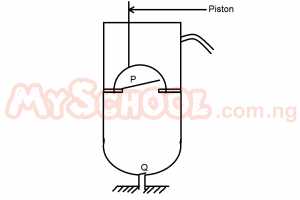 The diagram above shows a lift pump with valves at P and Q. During a downward stroke of the piston
- A. both valves are open
- B. P is open while Q is closed
- C. P is closed while Q is open
- D. Both valves are closed
Correct Answer: B
Explanation
To understand the operation of a lift pump during a downward stroke of the piston, we need to analyze how the valves (P and Q) function in relation to the movement of the piston and the fluid dynamics involved.
### Correct Option: B (P is open while Q is closed)
#### Explanation of Why Option B is Correct:
1. **Understanding the Lift Pump Mechanism**:
- A lift pump typically consists of a piston that moves up and down within a cylinder. The movement of the piston creates changes in pressure that allow fluid to be drawn into the pump and then expelled.
- The pump has two valves: one at the inlet (P) and one at the outlet (Q). The inlet valve (P) allows fluid to enter the pump, while the outlet valve (Q) allows fluid to exit the pump.
2. **Downward Stroke of the Piston**:
- When the piston moves downward, it decreases the volume inside the cylinder. According to the principles of fluid dynamics, this creates a pressure increase within the cylinder.
- As the pressure inside the cylinder rises, it affects the state of the valves:
- The inlet valve (P) must be open to allow fluid to enter the pump from the reservoir or source.
- The outlet valve (Q) must be closed to prevent the fluid that has already been pumped from flowing back into the cylinder.
3. **Pressure Dynamics**:
- When the piston moves down, the pressure at the inlet (P) becomes lower than the pressure in the reservoir, allowing fluid to flow into the pump through valve P.
- Conversely, the pressure at the outlet (Q) is higher due to the fluid being pushed out of the pump. Therefore, valve Q must remain closed to maintain the pressure and ensure that the fluid does not flow back into the pump.
4. **Conclusion**:
- During the downward stroke of the piston, valve P is open to allow fluid to enter, while valve Q is closed to prevent backflow. This is why option B is the correct answer.
#### Explanation of Why Other Options are Wrong:
- **Option A: Both valves are open**:
- This option is incorrect because if both valves were open during the downward stroke, the fluid would not be able to build up pressure in the cylinder. Fluid would flow freely in and out, preventing the pump from functioning effectively.
- **Option C: P is closed while Q is open**:
- This option is also incorrect. If valve P is closed, no fluid can enter the pump during the downward stroke. If valve Q is open, it would allow fluid to escape, which contradicts the purpose of the downward stroke, where we want to draw fluid in.
- **Option D: Both valves are closed**:
- This option is incorrect as well. If both valves are closed, the pump would not be able to draw in any fluid or expel any fluid. The pump would be effectively non-functional during the downward stroke.
### Summary of Key Points:
- During the downward stroke of a lift pump, valve P must be open to allow fluid to enter, while valve Q must be closed to prevent backflow.
- The pressure dynamics created by the movement of the piston dictate the state of the valves.
- Understanding the function of each valve is crucial for grasping how lift pumps operate effectively.
### Revision Summary:
- Lift pumps use pistons to create pressure changes for fluid movement.
- During a downward stroke, valve P is open (allowing fluid in) and valve Q is closed (preventing backflow).
- Incorrect valve states (both open, P closed, or Q open) would disrupt the pump's operation.
- Mastering the function of valves in fluid dynamics is essential for understanding pump mechanics.