Question 141 of 949
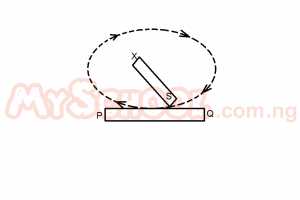 The diagram above shows a magnet X with its south pole moved along a soft - iron bar PQ in the direction shown. After some time, the poles at P and Q respectively are
- A. North - North
- B. North - South
- C. South - North
- D. South - South
Correct Answer: B
Explanation
To understand the behavior of the magnet and the soft iron bar in the given scenario, let's break down the concepts involved step-by-step.
### Correct Option: B. North - South
### Explanation of Why the Answer is Correct:
1. **Understanding Magnetism**:
- A magnet has two poles: a North pole and a South pole. When a magnet is brought close to a ferromagnetic material (like soft iron), it can induce magnetism in that material.
2. **Induction of Magnetism**:
- When the South pole of magnet X is moved towards the soft iron bar PQ, it induces magnetism in the bar. The side of the bar that is closest to the South pole of the magnet will become a North pole due to the principle of magnetic induction. This is because opposite poles attract.
3. **Behavior of the Soft Iron Bar**:
- As the South pole of the magnet approaches the bar, the end of the bar closest to the South pole (let's call it point P) will become a North pole. This is because the magnetic field lines from the South pole of the magnet enter the bar and cause the atoms in the iron to align in such a way that they create a North pole at that end.
4. **The Other End of the Bar**:
- The far end of the bar (point Q) will become a South pole. This is because the induced North pole at point P repels the North pole of the magnet, and thus the far end of the bar must be a South pole to maintain the magnetic balance.
5. **Final Configuration**:
- Therefore, after the South pole of the magnet has moved along the bar, we have:
- Point P (the end closest to the magnet) becomes a North pole.
- Point Q (the far end) becomes a South pole.
### Why the Other Options are Incorrect:
- **Option A: North - North**:
- This would imply that both ends of the bar are North poles. This is impossible because like poles repel each other, and the magnet would not be able to induce a North pole at point P if it were already a North pole.
- **Option C: South - North**:
- This configuration suggests that point P is a South pole and point Q is a North pole. This is incorrect because the South pole of the magnet induces a North pole at point P, not a South pole.
- **Option D: South - South**:
- This option suggests that both ends of the bar are South poles. Similar to option A, this is impossible because like poles repel each other, and the magnet would not be able to induce a South pole at point P if it were already a South pole.
### Summary of Key Concepts:
- **Magnetic Induction**: A magnet can induce magnetism in ferromagnetic materials, creating poles in the material.
- **Opposite Poles Attract**: The South pole of a magnet induces a North pole in the material it approaches.
- **Pole Configuration**: The end of the bar closest to the magnet becomes a North pole, while the far end becomes a South pole.
### Revision Summary:
- A magnet induces opposite poles in a ferromagnetic material.
- The South pole of a magnet induces a North pole in the material it approaches.
- The configuration after induction will be North at the end closest to the magnet and South at the far end.
- Understanding the behavior of magnetic poles is crucial for solving problems related to magnetism.