Question 144 of 949
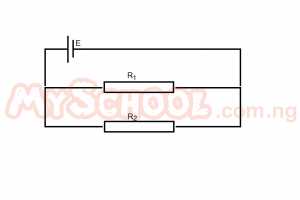 In the diagram above, if the internal resistance of the cell is zero, the ration of the powers P1 and P2 dissipated by R1 and R2
- A. R2/R1
- B. R1/R2
- C. R1+R2/R1
- D. R1+R2/R2
Correct Answer: A
Explanation
To solve the problem regarding the power dissipated by resistors \( R_1 \) and \( R_2 \) in a circuit, we need to understand how power is calculated in resistive circuits and how resistors behave in series and parallel configurations.
### Step-by-Step Explanation
1. **Understanding Power in Resistors**:
The power \( P \) dissipated by a resistor can be calculated using the formula:
\[
P = I^2 R
\]
where \( I \) is the current flowing through the resistor and \( R \) is the resistance.
2. **Analyzing the Circuit**:
In the given circuit, we have two resistors \( R_1 \) and \( R_2 \). Since the internal resistance of the cell is zero, we can assume that the entire voltage from the cell is applied across the resistors.
3. **Current Distribution**:
If \( R_1 \) and \( R_2 \) are connected in parallel, the voltage across both resistors is the same. Let's denote the voltage across the resistors as \( V \). The current through each resistor can be expressed as:
\[
I_1 = \frac{V}{R_1} \quad \text{and} \quad I_2 = \frac{V}{R_2}
\]
4. **Calculating Power for Each Resistor**:
Using the power formula for each resistor:
- For \( R_1 \):
\[
P_1 = I_1^2 R_1 = \left(\frac{V}{R_1}\right)^2 R_1 = \frac{V^2}{R_1}
\]
- For \( R_2 \):
\[
P_2 = I_2^2 R_2 = \left(\frac{V}{R_2}\right)^2 R_2 = \frac{V^2}{R_2}
\]
5. **Finding the Ratio of Powers**:
Now, we can find the ratio of the powers \( P_1 \) and \( P_2 \):
\[
\frac{P_1}{P_2} = \frac{\frac{V^2}{R_1}}{\frac{V^2}{R_2}} = \frac{R_2}{R_1}
\]
This means that the ratio of the powers dissipated by \( R_1 \) and \( R_2 \) is:
\[
\frac{P_1}{P_2} = \frac{R_2}{R_1}
\]
6. **Identifying the Correct Option**:
The question asks for the ratio of the powers \( P_1 \) and \( P_2 \). Since we found that:
\[
\frac{P_1}{P_2} = \frac{R_2}{R_1}
\]
This corresponds to option **A**: \( \frac{R_2}{R_1} \).
### Why Other Options Are Incorrect
- **Option B: \( \frac{R_1}{R_2} \)**:
This option suggests that the power in \( R_1 \) is greater than that in \( R_2 \) when the opposite is true based on our calculations.
- **Option C: \( \frac{R_1 + R_2}{R_1} \)**:
This option does not represent the ratio of powers but rather a different relationship that does not apply to the power dissipation in parallel resistors.
- **Option D: \( \frac{R_1 + R_2}{R_2} \)**:
Similar to option C, this does not reflect the correct relationship for power dissipation in the context of the given circuit.
### Common Pitfalls
- **Misunderstanding Circuit Configuration**: Ensure you know whether resistors are in series or parallel, as this affects current and voltage distribution.
- **Forgetting to Square the Current**: When calculating power, remember that power is proportional to the square of the current, which can lead to incorrect ratios if overlooked.
### Revision Summary
- Power in a resistor is given by \( P = I^2 R \).
- For resistors in parallel, the voltage across each is the same, leading to different currents.
- The ratio of powers for resistors in parallel is given by \( \frac{P_1}{P_2} = \frac{R_2}{R_1} \).
- The correct answer is option **A**: \( \frac{R_2}{R_1} \).