Question 145 of 949
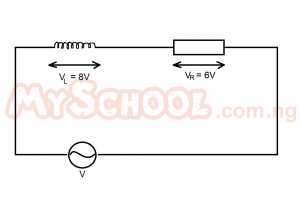 In the series a.c circuit shown above, the p.d across the inductor is 8Vr.m.s and that across the resistor is 6Vr.m.s. The effective voltage is
- A. 2V
- B. 10V
- C. 14V
- D. 48V
Correct Answer: B
Explanation
To solve the problem of finding the effective voltage in a series AC circuit with an inductor and a resistor, we need to understand how voltages behave in such circuits.
### Given Data:
- Voltage across the inductor, \( V_L = 8 \, \text{V}_{\text{r.m.s}} \)
- Voltage across the resistor, \( V_R = 6 \, \text{V}_{\text{r.m.s}} \)
### Step-by-Step Explanation:
1. **Understanding AC Circuit Components**:
- In an AC circuit, the voltage across different components (like resistors and inductors) can be out of phase. This means that the voltages do not simply add up algebraically; instead, we need to consider their phase relationship.
2. **Using the Pythagorean Theorem**:
- In a series AC circuit, the total effective voltage (or the root mean square voltage) can be calculated using the Pythagorean theorem. This is because the voltages across the resistor and inductor are at right angles to each other in the phasor diagram.
- The formula to find the total effective voltage \( V \) is:
\[
V = \sqrt{V_R^2 + V_L^2}
\]
3. **Calculating the Effective Voltage**:
- Plugging in the values:
\[
V = \sqrt{(6 \, \text{V})^2 + (8 \, \text{V})^2}
\]
\[
V = \sqrt{36 + 64}
\]
\[
V = \sqrt{100}
\]
\[
V = 10 \, \text{V}_{\text{r.m.s}}
\]
4. **Conclusion**:
- Therefore, the effective voltage across the circuit is \( 10 \, \text{V}_{\text{r.m.s}} \).
### Why the Other Options are Incorrect:
- **Option A: 2V**: This value does not correspond to any calculation based on the given voltages. It is too low and does not consider the contributions of both the resistor and inductor.
- **Option C: 14V**: This option suggests a simple addition of the two voltages, which is incorrect because it ignores the phase difference between the voltages across the resistor and inductor.
- **Option D: 48V**: This value is significantly higher than what can be derived from the given voltages. It does not relate to the problem at all.
### Common Pitfalls:
- **Ignoring Phase Relationships**: A common mistake is to add the voltages directly without considering their phase difference. Always remember that in AC circuits, voltages across inductors and resistors are not in phase.
- **Misunderstanding RMS Values**: Ensure that you recognize that the voltages given are RMS values, which are used in AC circuit calculations.
### Revision Summary:
- In a series AC circuit, voltages across components can be out of phase.
- Use the Pythagorean theorem to calculate the total effective voltage: \( V = \sqrt{V_R^2 + V_L^2} \).
- The effective voltage for the given values is \( 10 \, \text{V}_{\text{r.m.s}} \).
- Always consider phase relationships in AC circuits to avoid incorrect calculations.