Question 140 of 949
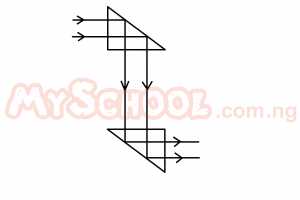 The diagram above shows the prism arrangement in a
- A. binocular
- B. spectrometer
- C. periscope
- D. projector
Correct Answer: C
Explanation
To determine the correct answer regarding the prism arrangement shown in the diagram, let's analyze each option and understand the function of prisms in various optical devices.
### Correct Option: C. Periscope
#### Explanation of Why C is Correct:
A periscope is an optical instrument that allows an observer to see objects that are not in their direct line of sight. It typically consists of two mirrors or prisms arranged at 45-degree angles to each other. The light enters the top of the periscope, reflects off the first prism, travels down the tube, and then reflects off the second prism to reach the observer's eye.
In the context of the question, if the diagram shows a setup with prisms arranged at angles that facilitate the redirection of light, it is indicative of a periscope. The key feature of a periscope is its ability to change the direction of light using prisms or mirrors, allowing for viewing over obstacles.
#### Why Other Options Are Incorrect:
- **A. Binocular**:
- Binoculars use a combination of lenses and prisms to magnify distant objects and provide a three-dimensional view. While they do contain prisms, the arrangement is more complex and typically involves multiple lenses and prisms to achieve magnification and correct orientation. If the diagram shows a simple arrangement of prisms without the complexity of lenses, it is not representative of binoculars.
- **B. Spectrometer**:
- A spectrometer is an instrument used to measure properties of light over a specific portion of the electromagnetic spectrum. It typically involves a prism or diffraction grating to disperse light into its component colors. The arrangement in a spectrometer is designed to analyze light rather than redirect it for viewing, which is not the primary function of a periscope.
- **D. Projector**:
- A projector is used to display images or videos onto a surface. It primarily uses lenses to focus and enlarge images rather than prisms to redirect light. While some projectors may use prisms in their internal mechanisms, the main function is not related to the arrangement of prisms for viewing, making this option less relevant.
### Summary of Key Points:
- A periscope uses prisms or mirrors to redirect light, allowing observation from a concealed position.
- Binoculars involve a more complex arrangement of lenses and prisms for magnification.
- Spectrometers analyze light rather than redirect it for viewing.
- Projectors focus images using lenses, not primarily prisms.
### Revision Summary:
- **Periscopes** redirect light using prisms to allow viewing over obstacles.
- **Binoculars** magnify images using a combination of lenses and prisms.
- **Spectrometers** analyze light spectra, not for direct viewing.
- **Projectors** display images using lenses, not primarily prisms.
Understanding the specific functions and arrangements of optical devices is crucial for identifying them correctly based on their components.