Question 142 of 949
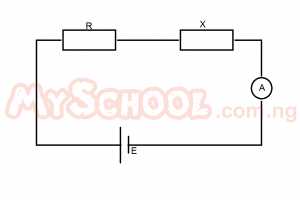 In the circuit above, the ammeter reads a current of 5.0 A when R = 8Ω and reads 7.0A when R = 5Ω. The value of the unknown resistance X is
- A. 10.0Ω
- B. 7.5Ω
- C. 5.0Ω
- D. 2.5Ω
Correct Answer: D
Explanation
To solve the problem, we need to analyze the circuit and apply Ohm's Law, which states that \( V = I \times R \), where \( V \) is the voltage, \( I \) is the current, and \( R \) is the resistance.
### Step-by-Step Explanation
1. **Understanding the Circuit**:
- The circuit consists of a voltage source (which we will denote as \( V \)) and two resistors: the unknown resistance \( X \) and a variable resistor \( R \). The ammeter measures the current flowing through the circuit.
2. **Using the Given Data**:
- When \( R = 8 \, \Omega \), the current \( I_1 = 5.0 \, A \).
- When \( R = 5 \, \Omega \), the current \( I_2 = 7.0 \, A \).
3. **Applying Ohm's Law**:
- For the first scenario (when \( R = 8 \, \Omega \)):
\[
V = I_1 \times (R + X) = 5.0 \times (8 + X)
\]
- For the second scenario (when \( R = 5 \, \Omega \)):
\[
V = I_2 \times (R + X) = 7.0 \times (5 + X)
\]
4. **Setting the Equations Equal**:
- Since the voltage \( V \) is the same in both cases, we can set the two equations equal to each other:
\[
5.0 \times (8 + X) = 7.0 \times (5 + X)
\]
5. **Expanding Both Sides**:
- Expanding the left side:
\[
40 + 5X
\]
- Expanding the right side:
\[
35 + 7X
\]
6. **Setting Up the Equation**:
- Now we have:
\[
40 + 5X = 35 + 7X
\]
7. **Rearranging the Equation**:
- To isolate \( X \), we can rearrange the equation:
\[
40 - 35 = 7X - 5X
\]
\[
5 = 2X
\]
8. **Solving for \( X \)**:
- Dividing both sides by 2 gives:
\[
X = \frac{5}{2} = 2.5 \, \Omega
\]
### Conclusion
The value of the unknown resistance \( X \) is **2.5Ω**, which corresponds to option **D**.
### Explanation of Other Options
- **Option A (10.0Ω)**: This value is too high based on the current readings. If \( X \) were 10Ω, the current would be significantly lower than observed.
- **Option B (7.5Ω)**: This value does not satisfy the equations derived from the current readings. It would lead to a voltage that does not match the conditions given.
- **Option C (5.0Ω)**: Similar to option B, this value does not satisfy the conditions of the circuit based on the current readings.
### Revision Summary
- Use Ohm's Law \( V = I \times R \) to analyze circuits.
- Set up equations based on different conditions in the circuit.
- Rearrange and solve for unknowns carefully.
- Always check if the derived value satisfies the original conditions of the problem.