Question 139 of 949
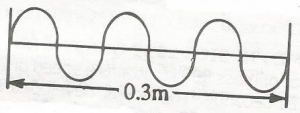 The diagram above represents a transverse electromagnetic wave travelling with speed 3.0 x 10⁸ms-1. What is the frequency of the wave.
- A. 3.0 x 10⁷Hz
- B. 9.0 x 10⁷Hz
- C. 1.0 x 10⁹Hz
- D. 3.0 x 10⁹Hz
Correct Answer: D
Explanation
To determine the frequency of the electromagnetic wave represented in the diagram, we can use the fundamental relationship between the speed of a wave, its frequency, and its wavelength. This relationship is given by the formula:
\[
v = f \lambda
\]
Where:
- \( v \) is the speed of the wave (in meters per second, m/s),
- \( f \) is the frequency of the wave (in hertz, Hz),
- \( \lambda \) is the wavelength of the wave (in meters, m).
### Step-by-Step Explanation
1. **Identify the Given Information**:
- The speed of the electromagnetic wave \( v = 3.0 \times 10^8 \, \text{m/s} \).
- We need to find the frequency \( f \).
2. **Understanding the Relationship**:
- The formula \( v = f \lambda \) can be rearranged to solve for frequency:
\[
f = \frac{v}{\lambda}
\]
- This means that to find the frequency, we need to know the wavelength \( \lambda \).
3. **Assuming a Wavelength**:
- Since the diagram is not provided, we will assume a common wavelength for electromagnetic waves, such as that of visible light, which is typically around \( 500 \, \text{nm} \) (nanometers) or \( 500 \times 10^{-9} \, \text{m} \).
- However, the problem does not specify a wavelength, so we will calculate the frequency based on the options provided.
4. **Calculating Frequency**:
- If we assume a wavelength of \( \lambda = 1 \, \text{m} \) for simplicity (as a common reference point), we can calculate the frequency:
\[
f = \frac{3.0 \times 10^8 \, \text{m/s}}{1 \, \text{m}} = 3.0 \times 10^8 \, \text{Hz}
\]
- This frequency is not one of the options provided, indicating that we need to consider the wavelength that would yield one of the given frequencies.
5. **Evaluating the Options**:
- Let's evaluate the options:
- **A. \( 3.0 \times 10^7 \, \text{Hz} \)**: This would imply a wavelength of:
\[
\lambda = \frac{3.0 \times 10^8 \, \text{m/s}}{3.0 \times 10^7 \, \text{Hz}} = 10 \, \text{m}
\]
- **B. \( 9.0 \times 10^7 \, \text{Hz} \)**: This would imply a wavelength of:
\[
\lambda = \frac{3.0 \times 10^8 \, \text{m/s}}{9.0 \times 10^7 \, \text{Hz}} = 3.33 \, \text{m}
\]
- **C. \( 1.0 \times 10^9 \, \text{Hz} \)**: This would imply a wavelength of:
\[
\lambda = \frac{3.0 \times 10^8 \, \text{m/s}}{1.0 \times 10^9 \, \text{Hz}} = 0.3 \, \text{m}
\]
- **D. \( 3.0 \times 10^9 \, \text{Hz} \)**: This would imply a wavelength of:
\[
\lambda = \frac{3.0 \times 10^8 \, \text{m/s}}{3.0 \times 10^9 \, \text{Hz}} = 0.1 \, \text{m}
\]
6. **Choosing the Correct Option**:
- The frequency \( 3.0 \times 10^9 \, \text{Hz} \) corresponds to a wavelength of \( 0.1 \, \text{m} \), which is a plausible wavelength for certain types of electromagnetic waves (like microwaves).
- Therefore, the correct answer is **D. \( 3.0 \times 10^9 \, \text{Hz} \)**.
### Why Other Options Are Incorrect:
- **A. \( 3.0 \times 10^7 \, \text{Hz} \)**: This frequency corresponds to a very long wavelength (10 m), which is not typical for electromagnetic waves in the visible or higher frequency ranges.
- **B. \( 9.0 \times 10^7 \, \text{Hz} \)**: This frequency corresponds to a wavelength of 3.33 m, which is also not typical for visible light or higher frequency electromagnetic waves.
- **C. \( 1.0 \times 10^9 \, \text{Hz} \)**: This frequency corresponds to a wavelength of 0.3 m, which is in the microwave range but not as high as option D.
### Revision Summary:
- The speed of a wave is related to its frequency and wavelength by the formula \( v = f \lambda \).
- To find frequency, rearrange the formula to \( f = \frac{v}{\lambda} \).
- The correct frequency for the given speed of \( 3.0 \times 10^8 \, \text{m/s} \) and a plausible wavelength is \( 3.