Question 138 of 949
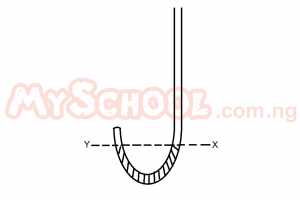 In the J-tube above, Y and X are on the same horizontal level and 30cm3 of air is trapped above Y when the atmospheric pressure is 75cm Hg, calculate the volume of air trapped above Y when 15cm Hg is now poured into the limb above X
- A. 15 cm3
- B. 25 cm3
- C. 35 cm3
- D. 45 cm3
Correct Answer: B
Explanation
To solve the problem, we need to understand how the pressure changes in the J-tube when additional mercury is added to one side. Let's break down the steps to find the volume of air trapped above Y after pouring 15 cm of mercury into the limb above X.
### Step-by-Step Explanation
1. **Understanding the Initial Conditions**:
- Initially, there is 30 cm³ of air trapped above Y.
- The atmospheric pressure is given as 75 cm Hg. This means that the pressure exerted by the air column above Y is equal to the atmospheric pressure.
2. **Using Boyle's Law**:
- Boyle's Law states that for a given mass of gas at constant temperature, the product of pressure (P) and volume (V) is constant: \( P_1 V_1 = P_2 V_2 \).
- Here, \( P_1 \) is the initial pressure, \( V_1 \) is the initial volume, \( P_2 \) is the final pressure, and \( V_2 \) is the final volume.
3. **Calculating Initial Pressure**:
- The initial pressure above Y (where the air is trapped) is the atmospheric pressure, which is 75 cm Hg.
4. **Adding Mercury**:
- When we pour 15 cm Hg of mercury into the limb above X, we are effectively increasing the pressure on the air trapped above Y.
- The new pressure above Y becomes:
\[
P_2 = P_{\text{atmospheric}} + P_{\text{mercury}} = 75 \text{ cm Hg} + 15 \text{ cm Hg} = 90 \text{ cm Hg}
\]
5. **Applying Boyle's Law**:
- Now we can apply Boyle's Law to find the new volume of air trapped above Y.
- Let \( V_2 \) be the new volume of air above Y. We know:
- \( P_1 = 75 \text{ cm Hg} \)
- \( V_1 = 30 \text{ cm}^3 \)
- \( P_2 = 90 \text{ cm Hg} \)
- Using Boyle's Law:
\[
P_1 V_1 = P_2 V_2
\]
\[
75 \text{ cm Hg} \times 30 \text{ cm}^3 = 90 \text{ cm Hg} \times V_2
\]
- Rearranging to solve for \( V_2 \):
\[
V_2 = \frac{75 \text{ cm Hg} \times 30 \text{ cm}^3}{90 \text{ cm Hg}} = \frac{2250 \text{ cm}^3 \text{ cm Hg}}{90 \text{ cm Hg}} = 25 \text{ cm}^3
\]
### Conclusion
The volume of air trapped above Y after pouring 15 cm Hg of mercury into the limb above X is **25 cm³**.
### Explanation of Other Options
- **Option A (15 cm³)**: This option is incorrect because it underestimates the volume of air remaining after the increase in pressure. The volume cannot decrease to this extent given the initial conditions.
- **Option C (35 cm³)**: This option is incorrect as it suggests that the volume increased, which contradicts Boyle's Law since the pressure increased.
- **Option D (45 cm³)**: This option is also incorrect because it implies a significant increase in volume, which is not possible under increased pressure conditions.
### Revision Summary
- Boyle's Law relates pressure and volume of a gas at constant temperature: \( P_1 V_1 = P_2 V_2 \).
- Adding mercury increases the pressure on the trapped air, reducing its volume.
- The new volume can be calculated by rearranging Boyle's Law.
- The correct answer is 25 cm³, as calculated from the initial and final pressures.