Question 136 of 949
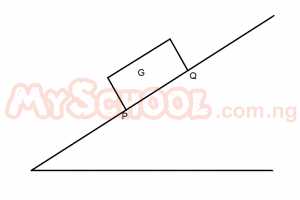 The diagram above shows a solid figure with base PQ and center of gravity G on a inclined plane. Which of the following statements is correct
- A. The solid will fall over if the vertical line through G lies outside the base
- B. The solid will fall over if the vertical line through lies inside the base
- C. The solid will not fall over if the vertical line through G lies outside the base
- D. The solid can never fall over
Correct Answer: A
Explanation
### Correct Option: A
**Explanation:**
To understand why option A is correct, we need to delve into the concepts of center of gravity, stability, and the conditions under which an object will topple over.
1. **Center of Gravity (G):** The center of gravity of an object is the point where its weight is evenly distributed in all directions. For a solid figure, this point is crucial in determining how the object behaves when subjected to forces, such as gravity.
2. **Base of Support:** The base of support is the area beneath an object that includes all points of contact with the ground. For stability, the center of gravity must be positioned directly above this base.
3. **Vertical Line through G:** When we draw a vertical line from the center of gravity (G) down to the ground, it helps us visualize the stability of the object. If this line falls within the base of support, the object is stable. If it falls outside the base, the object is at risk of toppling over.
4. **Condition for Toppling:** An object will fall over if the vertical line through its center of gravity (G) lies outside its base of support. This is because the weight of the object creates a torque about the edge of the base. If the center of gravity is too far from the base, the torque will cause the object to rotate and fall.
### Why Other Options Are Incorrect:
- **Option B:** "The solid will fall over if the vertical line through G lies inside the base."
- This statement is incorrect because if the vertical line through G lies inside the base, the object is stable. The weight is balanced over the base, and there is no torque to cause it to topple.
- **Option C:** "The solid will not fall over if the vertical line through G lies outside the base."
- This statement is also incorrect. If the vertical line through G lies outside the base, the object is unstable and will indeed fall over due to the torque created by its weight.
- **Option D:** "The solid can never fall over."
- This statement is misleading. While some objects are designed to be very stable, any object can fall over if its center of gravity is not properly aligned over its base of support. Therefore, this statement is too absolute and does not account for the conditions that lead to toppling.
### Summary of Key Concepts:
- The center of gravity (G) is crucial for determining stability.
- An object is stable if the vertical line through G falls within its base of support.
- An object will topple if the vertical line through G falls outside its base.
- Understanding the relationship between center of gravity and base of support is essential for analyzing stability in physics.
### Revision Summary:
- The center of gravity (G) determines an object's stability.
- An object is stable if the vertical line through G is within the base of support.
- An object will topple if the vertical line through G is outside the base.
- Always consider the base of support when analyzing stability in solid figures.