Question 163 of 949
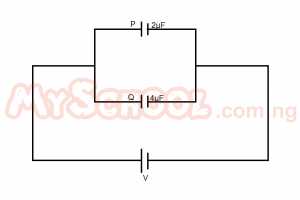 The diagram above shows two capacitors P and Q of capacitance 2μF and 4μF respectively connected to a d.c source. The ratio of energy stored in P to Q is
- A. 4:1
- B. 2:1
- C. 1:4
- D. 1:2
Correct Answer: D
Explanation
To determine the ratio of energy stored in capacitors P and Q, we first need to understand how energy is stored in a capacitor. The energy (E) stored in a capacitor can be calculated using the formula:
\[
E = \frac{1}{2} C V^2
\]
where:
- \(E\) is the energy stored in joules (J),
- \(C\) is the capacitance in farads (F),
- \(V\) is the voltage across the capacitor in volts (V).
### Step-by-Step Explanation
1. **Identify the Capacitance Values**:
- Capacitor P has a capacitance of \(C_P = 2 \, \mu F = 2 \times 10^{-6} \, F\).
- Capacitor Q has a capacitance of \(C_Q = 4 \, \mu F = 4 \times 10^{-6} \, F\).
2. **Assume a Common Voltage**:
- For the sake of comparison, let’s assume both capacitors are connected to the same voltage source \(V\). The actual value of \(V\) will cancel out in the ratio, so we can keep it as a variable.
3. **Calculate the Energy Stored in Each Capacitor**:
- For capacitor P:
\[
E_P = \frac{1}{2} C_P V^2 = \frac{1}{2} (2 \times 10^{-6}) V^2 = (1 \times 10^{-6}) V^2
\]
- For capacitor Q:
\[
E_Q = \frac{1}{2} C_Q V^2 = \frac{1}{2} (4 \times 10^{-6}) V^2 = (2 \times 10^{-6}) V^2
\]
4. **Find the Ratio of Energies**:
- Now, we can find the ratio of the energy stored in capacitor P to that in capacitor Q:
\[
\text{Ratio} = \frac{E_P}{E_Q} = \frac{(1 \times 10^{-6}) V^2}{(2 \times 10^{-6}) V^2}
\]
- The \(V^2\) terms cancel out:
\[
\text{Ratio} = \frac{1}{2}
\]
5. **Final Result**:
- Therefore, the ratio of energy stored in capacitor P to that in capacitor Q is \(1:2\).
### Explanation of Options
- **Option A: 4:1** - This option suggests that capacitor P stores four times the energy of capacitor Q, which is incorrect based on our calculations.
- **Option B: 2:1** - This option implies that capacitor P stores twice the energy of capacitor Q, which is also incorrect.
- **Option C: 1:4** - This option suggests that capacitor P stores one-fourth the energy of capacitor Q, which is not supported by our findings.
- **Option D: 1:2** - This is the correct option, as we calculated that the energy stored in capacitor P is half that stored in capacitor Q.
### Common Pitfalls
- **Ignoring Voltage**: A common mistake is to forget that the voltage across both capacitors is the same when they are connected in parallel to the same source.
- **Misunderstanding Capacitance**: Some students may confuse capacitance with energy storage; higher capacitance does not always mean more energy stored unless the voltage is also considered.
### Revision Summary
- The energy stored in a capacitor is given by \(E = \frac{1}{2} C V^2\).
- The ratio of energies stored in capacitors depends on their capacitance values when connected to the same voltage.
- For capacitors P (2μF) and Q (4μF), the ratio of energy stored is \(1:2\).
- Always ensure to consider the voltage across capacitors when calculating energy ratios.