Question 165 of 949
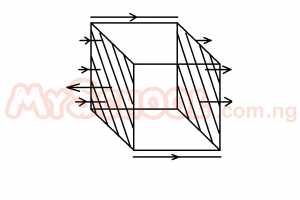 The diagram above shows a closed side 0.5m in a uniform electric field E in the direction shown by the arrows. What is the flux Φ for the box?
- A. 0.5 E
- B. 2.0 E
- C. 0.2 E
- D. 0.0 E
Correct Answer: D
Explanation
To determine the electric flux (Φ) through the closed surface (the box) in a uniform electric field (E), we need to understand the concept of electric flux and how it is calculated.
### Step-by-Step Explanation
1. **Understanding Electric Flux**:
Electric flux (Φ) through a surface is defined as the product of the electric field (E) and the area (A) of the surface projected in the direction of the field. Mathematically, it is given by:
\[
\Phi = E \cdot A \cdot \cos(\theta)
\]
where:
- \(E\) is the magnitude of the electric field,
- \(A\) is the area of the surface,
- \(\theta\) is the angle between the electric field lines and the normal (perpendicular) to the surface.
2. **Analyzing the Given Diagram**:
- The box has one side that is closed, and the electric field is uniform and directed in a specific direction (as indicated by the arrows).
- The closed side of the box is 0.5 m in length, but we need to determine the area of the surface that is exposed to the electric field.
3. **Calculating the Area**:
- If we assume the closed side of the box is a square with a side length of 0.5 m, the area \(A\) of that side is:
\[
A = \text{side}^2 = (0.5 \, \text{m})^2 = 0.25 \, \text{m}^2
\]
4. **Direction of the Electric Field**:
- The electric field is uniform and directed in a specific direction. If the closed side of the box is perpendicular to the electric field, then \(\theta = 0^\circ\) and \(\cos(0) = 1\). However, if the closed side is parallel to the electric field, then \(\theta = 90^\circ\) and \(\cos(90) = 0\).
5. **Calculating the Flux**:
- If the closed side of the box is perpendicular to the electric field, the flux through that side would be:
\[
\Phi = E \cdot A \cdot \cos(0) = E \cdot 0.25 \, \text{m}^2
\]
- However, if the closed side is parallel to the electric field, the flux through that side would be:
\[
\Phi = E \cdot A \cdot \cos(90) = E \cdot 0.25 \, \text{m}^2 \cdot 0 = 0
\]
6. **Considering the Entire Closed Surface**:
- For a closed surface, the total electric flux is the sum of the flux through all sides. If one side has zero flux (because it is parallel to the electric field), and if the other sides also do not contribute to the net flux (for example, if they are also parallel to the field), the total flux through the closed surface will be zero.
### Conclusion
Given that the closed side of the box is parallel to the electric field, the total electric flux (Φ) through the closed surface is:
\[
\Phi = 0.0 \, E
\]
### Why Other Options Are Incorrect:
- **Option A (0.5 E)**: This suggests that there is a non-zero flux through the closed surface, which contradicts our analysis that the closed side is parallel to the electric field.
- **Option B (2.0 E)**: This implies a much larger flux, which is not possible since the area and orientation do not support this value.
- **Option C (0.2 E)**: This also suggests a non-zero flux, which is incorrect based on the orientation of the electric field relative to the closed surface.
### Revision Summary:
- Electric flux (Φ) is calculated using the formula \(Φ = E \cdot A \cdot \cos(\theta)\).
- The orientation of the surface relative to the electric field is crucial in determining the flux.
- If the surface is parallel to the electric field, the flux through that surface is zero.
- For a closed surface with no net contribution from any side, the total flux is zero.
Thus, the correct answer is **D. 0.0 E**.