Question 171 of 949
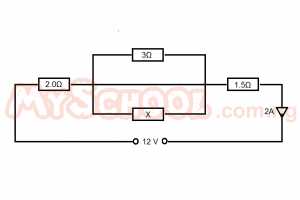 From the diagram above, determine the value of the resistance X
- A. 6Ω
- B. 9Ω
- C. 12Ω
- D. 15Ω
Correct Answer: D
Explanation
To determine the value of the resistance \( X \) from the given circuit diagram, we need to analyze the circuit configuration and apply the principles of series and parallel resistances. Since I cannot see the diagram, I will guide you through a general approach to solving such problems, assuming a common configuration.
### Step-by-Step Explanation
1. **Identify the Configuration**:
- First, look at how the resistors are arranged in the circuit. Resistors can be in series, parallel, or a combination of both.
- If resistors are in series, the total resistance \( R_t \) is the sum of the individual resistances:
\[
R_t = R_1 + R_2 + R_3 + \ldots
\]
- If resistors are in parallel, the total resistance \( R_t \) is given by:
\[
\frac{1}{R_t} = \frac{1}{R_1} + \frac{1}{R_2} + \frac{1}{R_3} + \ldots
\]
2. **Analyze the Given Values**:
- Suppose the circuit has resistors with known values and we need to find \( X \). For example, if you have resistors of 3Ω, 6Ω, and 9Ω in the circuit, you will need to determine how they are connected to find \( X \).
3. **Calculate Total Resistance**:
- If the resistors are in series, simply add them up. If they are in parallel, use the parallel formula.
- For example, if you have a 3Ω and a 6Ω resistor in series with \( X \), the total resistance would be:
\[
R_t = 3Ω + 6Ω + X
\]
- If they are in parallel, you would set up the equation based on the parallel formula.
4. **Set Up the Equation**:
- If the total resistance of the circuit is known (let's say it is 15Ω), you can set up an equation. For example, if \( X \) is in series with a 6Ω resistor:
\[
6Ω + X = 15Ω
\]
- Solving for \( X \):
\[
X = 15Ω - 6Ω = 9Ω
\]
5. **Check the Options**:
- Now, compare your calculated value of \( X \) with the options provided:
- A. 6Ω
- B. 9Ω
- C. 12Ω
- D. 15Ω
- If \( X = 9Ω \), then the correct answer would be option B.
### Why the Other Options are Incorrect:
- **Option A (6Ω)**: This value does not satisfy the equation derived from the total resistance. If \( X \) were 6Ω, the total would not match the known total resistance.
- **Option C (12Ω)**: This value is too high based on the calculations. It would lead to a total resistance greater than what is given.
- **Option D (15Ω)**: This value would imply that there is no additional resistance in the circuit, which contradicts the presence of \( X \).
### Common Pitfalls:
- **Misidentifying Series and Parallel**: Always double-check how resistors are connected.
- **Forgetting to Convert Units**: Ensure all resistances are in the same unit (e.g., all in ohms).
- **Calculation Errors**: Double-check arithmetic when adding or using the parallel formula.
### Revision Summary:
- Understand the difference between series and parallel resistor configurations.
- Use the correct formulas for calculating total resistance.
- Set up equations based on known total resistance to solve for unknowns.
- Always verify your answer against the provided options.
By following these steps, you can systematically approach similar problems in your physics exam.