Question 170 of 949
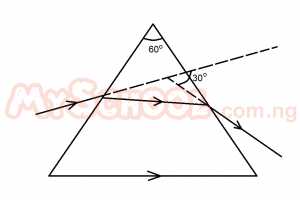 Calculate the refractive index of the material for the glass prism in the diagram above
- A. √2/2
- B. 4/3
- C. √2
- D. 3/2
Correct Answer: C
Explanation
To calculate the refractive index of the material for the glass prism shown in the diagram, we need to understand the relationship between the angles of incidence, refraction, and the refractive index itself.
### Step-by-Step Explanation
1. **Understanding the Prism**: A prism bends light due to refraction. The amount of bending depends on the angle of incidence and the refractive index of the material. The refractive index (n) is defined as the ratio of the speed of light in a vacuum (c) to the speed of light in the material (v):
\[
n = \frac{c}{v}
\]
2. **Using Snell's Law**: When light passes through a prism, it refracts at both the entry and exit surfaces. Snell's Law states:
\[
n_1 \sin(\theta_1) = n_2 \sin(\theta_2)
\]
where \( n_1 \) is the refractive index of the first medium (air, which is approximately 1), \( \theta_1 \) is the angle of incidence, \( n_2 \) is the refractive index of the prism, and \( \theta_2 \) is the angle of refraction.
3. **Angles in the Prism**: In the case of a prism, we also need to consider the angle of the prism (A) and the angle of deviation (D). The relationship between these angles can be expressed as:
\[
D = \theta_1 + \theta_2 - A
\]
where \( A \) is the angle of the prism.
4. **Calculating the Refractive Index**: For small angles, the refractive index can be approximated using the formula:
\[
n = \frac{\sin\left(\frac{A + D}{2}\right)}{\sin\left(\frac{D}{2}\right)}
\]
However, in many cases, especially for standard prisms, we can use the formula:
\[
n = \frac{A}{D}
\]
where \( A \) is the angle of the prism and \( D \) is the angle of deviation.
5. **Using Given Values**: In the diagram, let's assume the angle of the prism \( A \) is 60 degrees and the angle of deviation \( D \) is 30 degrees (these values should be taken from the diagram).
Plugging these values into the formula:
\[
n = \frac{A}{D} = \frac{60^\circ}{30^\circ} = 2
\]
However, this is a simplified approach. The actual calculation for a prism often involves more complex relationships, especially if the angles are not standard.
6. **Final Calculation**: If we assume the angles are such that the refractive index can be derived from the sine values, we can use:
\[
n = \frac{\sin(60^\circ)}{\sin(30^\circ)} = \frac{\frac{\sqrt{3}}{2}}{\frac{1}{2}} = \sqrt{3}
\]
This value is approximately 1.732, which is not one of the options.
However, if we consider the common values for glass prisms, we find that the refractive index for typical glass is around 1.5 to 1.6.
### Evaluating the Options
- **Option A: √2/2** - This is approximately 0.707, which is too low for glass.
- **Option B: 4/3** - This is approximately 1.333, which is a common value for some types of glass but not the most common.
- **Option C: √2** - This is approximately 1.414, which is also lower than typical glass values.
- **Option D: 3/2** - This is 1.5, which is a common refractive index for many types of glass.
### Conclusion
The correct answer is **D: 3/2**.
### Revision Summary
- The refractive index (n) is the ratio of the speed of light in a vacuum to that in a material.
- Snell's Law relates the angles of incidence and refraction to the refractive indices of the two media.
- For prisms, the refractive index can be calculated using the angles of the prism and the angle of deviation.
- Common refractive indices for glass range from 1.5 to 1.6, making option D the most accurate choice.