Question 169 of 949
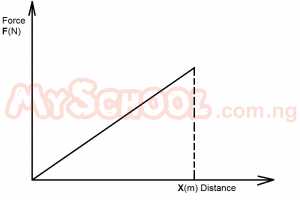 The diagram above shows the force (F) acting on an object through a distance (x). The work done on this object is expressed as
- A. Fx J
- B. Fx/2 J
- C. Fx2 J
- D. F/x J
Correct Answer: B
Explanation
To determine the correct expression for the work done on an object when a force \( F \) acts on it through a distance \( x \), we need to understand the concept of work in physics.
### Step-by-Step Explanation
1. **Understanding Work**:
Work is defined as the product of the force applied to an object and the distance over which that force is applied. The formula for work \( W \) is given by:
\[
W = F \cdot d \cdot \cos(\theta)
\]
where:
- \( W \) is the work done (in joules, J),
- \( F \) is the magnitude of the force applied (in newtons, N),
- \( d \) is the distance moved by the object in the direction of the force (in meters, m),
- \( \theta \) is the angle between the force and the direction of motion.
2. **Assuming Constant Force**:
In many problems, we assume that the force \( F \) is constant and acts in the same direction as the displacement \( x \). In this case, the angle \( \theta \) is 0 degrees, and \( \cos(0) = 1 \). Therefore, the formula simplifies to:
\[
W = F \cdot x
\]
3. **Analyzing the Options**:
- **Option A: \( Fx \) J**: This option correctly represents the work done when a constant force \( F \) acts over a distance \( x \). This is a valid expression for work.
- **Option B: \( \frac{Fx}{2} \) J**: This option suggests that the work done is half of the product of force and distance. This could be relevant in specific scenarios, such as when considering average force over a distance where the force varies linearly (like in a spring). However, it is not the general case for constant force.
- **Option C: \( Fx^2 \) J**: This option implies that work is proportional to the square of the distance, which is incorrect. Work is linearly proportional to distance when force is constant.
- **Option D: \( \frac{F}{x} \) J**: This option suggests an inverse relationship between force and distance, which does not align with the definition of work.
4. **Correct Answer**:
The correct expression for the work done when a constant force \( F \) acts over a distance \( x \) is:
\[
W = Fx \text{ J}
\]
Therefore, the correct option is **A**.
### Why Option B is Incorrect:
While option B states \( \frac{Fx}{2} \), this expression could be relevant in specific contexts (like average work done when force varies), it does not represent the general case of work done by a constant force over a distance. Thus, it is not the correct answer for the question posed.
### Summary of Key Points:
- Work is calculated as \( W = F \cdot x \) when force is constant and acts in the direction of motion.
- The correct expression for work done is \( Fx \) J.
- Options that suggest variations or inverses of force and distance do not align with the fundamental definition of work.
- Always consider the context of the problem to determine if the force is constant or varying.
### Revision Summary:
- Work done \( W = F \cdot x \) for constant force.
- Correct option for work done is \( Fx \) J.
- Be cautious of options that imply incorrect relationships (like \( Fx^2 \) or \( \frac{F}{x} \)).
- Understand the context of force application to apply the correct formula.