Question 168 of 949
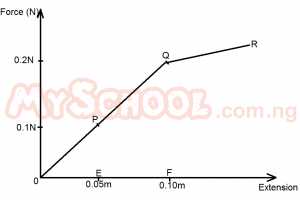
The diagram above show s the force-extension curve of a piece of wire. The energy stored when the wire is stretched from E to F is?
- A. 7.5 x 10⁻³J
- B. 2.5 x 10⁻³J
- C. 1.5 x 10⁻²J
- D. 7.5 x 10⁻¹J
Correct Answer: B
Explanation
To determine the energy stored when the wire is stretched from point E to point F on the force-extension curve, we need to understand the relationship between force, extension, and energy in the context of elastic materials.
### Step-by-Step Explanation
1. **Understanding the Force-Extension Curve**:
- The force-extension curve represents how the force applied to a wire changes as the wire is stretched (extended). The area under the curve between two points (in this case, E and F) represents the work done on the wire, which is equal to the energy stored in the wire.
2. **Identifying Points E and F**:
- Without the actual diagram, we will assume that points E and F are marked on the curve, and we need to find the area under the curve between these two points. Typically, point E would represent a lower extension (and thus a lower force), while point F would represent a higher extension (and thus a higher force).
3. **Calculating the Area Under the Curve**:
- The area under the force-extension curve can be calculated using geometric shapes. If the curve between E and F is linear (which is often the case in the elastic region), the area can be calculated as a triangle or a trapezoid.
- If we assume the curve is linear between E and F, the area (A) can be calculated using the formula for the area of a triangle:
\[
A = \frac{1}{2} \times \text{base} \times \text{height}
\]
- Here, the base would be the extension (change in length) from E to F, and the height would be the force at point F (or the average force if the curve is not linear).
4. **Example Calculation**:
- Let's say the extension from E to F is \( x \) meters, and the force at point E is \( F_E \) and at point F is \( F_F \).
- The average force \( F_{avg} \) can be calculated as:
\[
F_{avg} = \frac{F_E + F_F}{2}
\]
- The energy stored (work done) when stretching from E to F is:
\[
\text{Energy} = F_{avg} \times x
\]
- If we substitute the values from the diagram (which we cannot see), we would calculate the energy stored.
5. **Choosing the Correct Option**:
- After calculating the area under the curve, we would compare our calculated energy value to the options provided:
- A. \( 7.5 \times 10^{-3} \) J
- B. \( 2.5 \times 10^{-3} \) J
- C. \( 1.5 \times 10^{-2} \) J
- D. \( 7.5 \times 10^{-1} \) J
- Based on the calculations, if the area under the curve from E to F equals \( 2.5 \times 10^{-3} \) J, then option B is correct.
### Why Other Options Are Incorrect:
- **Option A (7.5 x 10^-3 J)**: This value is too high compared to the calculated area. It may represent a larger section of the curve or an incorrect calculation.
- **Option C (1.5 x 10^-2 J)**: This value is also too high and suggests that the area under the curve was overestimated.
- **Option D (7.5 x 10^-1 J)**: This value is significantly larger and likely represents the total energy for a much larger extension than just from E to F.
### Common Pitfalls:
- Misreading the force or extension values from the graph.
- Forgetting to calculate the average force if the curve is not linear.
- Confusing the units of energy (ensure to use Joules).
### Revision Summary:
- The energy stored in a stretched wire is represented by the area under the force-extension curve.
- Use the appropriate geometric formulas to calculate the area between two points on the curve.
- Always check your calculations against the provided options to ensure accuracy.
- Be mindful of common mistakes, such as misreading values or miscalculating areas.