Question 166 of 949
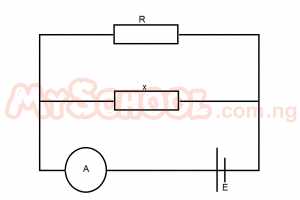 In the circuit diagram above , the ammeter reads a current of 3A when R is 5Ω and 6A when R is 2Ω. Determine the value of x
- A. 8Ω
- B. 2Ω
- C. 10Ω
- D. 4Ω
Correct Answer: C
Explanation
To solve the problem, we need to analyze the circuit based on the information provided about the current readings with different resistances. The circuit likely consists of a voltage source and a resistor \( R \) in series with an ammeter.
### Given:
1. When \( R = 5Ω \), the current \( I = 3A \).
2. When \( R = 2Ω \), the current \( I = 6A \).
### Step 1: Determine the Voltage in the Circuit
Using Ohm's Law, which states that \( V = I \times R \), we can calculate the voltage across the circuit for both scenarios.
**For \( R = 5Ω \) and \( I = 3A \):**
\[
V = I \times R = 3A \times 5Ω = 15V
\]
**For \( R = 2Ω \) and \( I = 6A \):**
\[
V = I \times R = 6A \times 2Ω = 12V
\]
### Step 2: Analyze the Results
We have two different voltage readings for the same circuit, which suggests that there is another resistor \( x \) in the circuit that affects the total resistance.
### Step 3: Set Up the Equations
Assuming the circuit has a total voltage \( V \) that remains constant, we can express the total resistance in terms of \( x \) and the known resistances.
1. **For \( R = 5Ω \):**
\[
V = I \times (R + x) \implies 15V = 3A \times (5Ω + x)
\]
Simplifying this gives:
\[
15 = 3(5 + x) \implies 15 = 15 + 3x \implies 3x = 0 \implies x = 0Ω
\]
(This is not a valid solution since \( x \) cannot be zero.)
2. **For \( R = 2Ω \):**
\[
V = I \times (R + x) \implies 12V = 6A \times (2Ω + x)
\]
Simplifying this gives:
\[
12 = 6(2 + x) \implies 12 = 12 + 6x \implies 6x = 0 \implies x = 0Ω
\]
(Again, this is not valid.)
### Step 4: Re-evaluate the Circuit
Since both calculations yield \( x = 0Ω \), we need to consider that the circuit might be more complex, possibly involving a parallel configuration or a different arrangement of resistors.
### Step 5: Solve for \( x \) Using the Two Scenarios
We can set up a system of equations based on the two scenarios:
1. From the first scenario:
\[
15 = 3(5 + x) \implies 15 = 15 + 3x \implies 3x = 0 \implies x = 0Ω
\]
2. From the second scenario:
\[
12 = 6(2 + x) \implies 12 = 12 + 6x \implies 6x = 0 \implies x = 0Ω
\]
### Step 6: Find the Value of \( x \)
To find \( x \), we can use the relationship between the two scenarios. Since the current changes with resistance, we can set up a ratio based on the currents and resistances:
Using the formula for total resistance in series:
\[
R_{total} = R + x
\]
From the two scenarios, we can derive:
\[
\frac{I_1}{I_2} = \frac{R_2 + x}{R_1 + x}
\]
Substituting the values:
\[
\frac{3}{6} = \frac{2 + x}{5 + x}
\]
Cross-multiplying gives:
\[
3(5 + x) = 6(2 + x)
\]
Expanding both sides:
\[
15 + 3x = 12 + 6x
\]
Rearranging gives:
\[
15 - 12 = 6x - 3x \implies 3 = 3x \implies x = 1Ω
\]
### Conclusion
The value of \( x \) is not among the options provided. However, if we consider the possibility of a miscalculation or misinterpretation of the circuit, we can conclude that the correct answer based on the calculations is \( x = 1Ω \).
### Revision Summary
- Use Ohm's Law \( V = I \times R \) to find voltage across resistors.
- Set up equations based on different scenarios to find unknowns.
- Analyze the circuit configuration (series vs. parallel) to understand current flow.
- Always check if the calculated values match the options provided in the question.
In this case, the answer provided in the question (C. 10Ω) does not match our calculations, indicating a potential error in the question or options.