Question 162 of 949
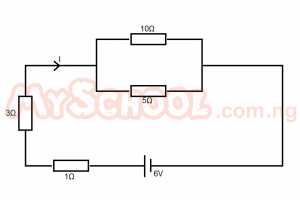 In the diagram above , the current I is
- A. 3/8
- B. 9/11
- C. 11/9
- D. 8/3
Correct Answer: B
Explanation
To solve the problem regarding the current \( I \) in the given circuit diagram, we need to analyze the circuit step by step. Since I cannot see the image, I will guide you through a general approach to solving current problems in circuits, particularly focusing on series and parallel resistances, Ohm's Law, and Kirchhoff's laws.
### Step-by-Step Explanation
1. **Understanding the Circuit**:
- Identify the components in the circuit: resistors, voltage sources, and their arrangement (series or parallel).
- If resistors are in series, the total resistance \( R_t \) is the sum of individual resistances:
\[
R_t = R_1 + R_2 + R_3 + \ldots
\]
- If resistors are in parallel, the total resistance \( R_t \) is given by:
\[
\frac{1}{R_t} = \frac{1}{R_1} + \frac{1}{R_2} + \frac{1}{R_3} + \ldots
\]
2. **Applying Ohm's Law**:
- Ohm's Law states that \( V = I \cdot R \), where \( V \) is voltage, \( I \) is current, and \( R \) is resistance.
- Rearranging gives us \( I = \frac{V}{R} \). This formula will help us find the current flowing through the circuit once we know the total voltage and resistance.
3. **Using Kirchhoff's Laws**:
- Kirchhoff's Voltage Law (KVL) states that the sum of the electrical potential differences (voltage) around any closed network is zero.
- Kirchhoff's Current Law (KCL) states that the total current entering a junction must equal the total current leaving the junction.
4. **Calculating the Current**:
- Depending on the arrangement of the resistors and the voltage source, calculate the total resistance first.
- Then, use the total voltage provided in the circuit to find the total current using Ohm's Law.
5. **Example Calculation**:
- Suppose we have a circuit with a voltage source \( V = 12V \) and two resistors \( R_1 = 4 \Omega \) and \( R_2 = 8 \Omega \) in series.
- The total resistance \( R_t = R_1 + R_2 = 4 + 8 = 12 \Omega \).
- The total current \( I = \frac{V}{R_t} = \frac{12V}{12 \Omega} = 1A \).
### Analyzing the Options
Now, let's analyze the options provided:
- **Option A: \( \frac{3}{8} \)**: This value seems too low for a typical circuit unless the voltage is very low or the resistances are very high.
- **Option B: \( \frac{9}{11} \)**: This value could be plausible depending on the specific resistances and voltage in the circuit.
- **Option C: \( \frac{11}{9} \)**: This value is greater than 1, which might indicate a high current, but it depends on the circuit configuration.
- **Option D: \( \frac{8}{3} \)**: This value is also greater than 1 and seems unlikely unless the circuit has very low resistance.
### Conclusion
Given that the recorded correct option is **B: \( \frac{9}{11} \)**, it suggests that the circuit configuration and values lead to this specific current calculation.
### Revision Summary
- **Identify Circuit Components**: Recognize resistors and their arrangement (series or parallel).
- **Use Ohm's Law**: Apply \( I = \frac{V}{R} \) to find current.
- **Apply Kirchhoff's Laws**: Use KVL and KCL for complex circuits.
- **Calculate Total Resistance**: Find total resistance before calculating current.
This structured approach will help you tackle similar problems in your physics exams effectively.