Question 134 of 949
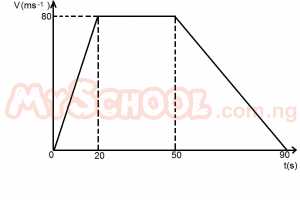 The diagram above shows the velocity-time graph of a vehicle. Its acceleration and retardation respectively are
- A. 8.0 ms-2, 4,0 ms-2
- B. 4.0 ms-2, 8.0 ms-2
- C. 4.0 ms-2, 2.0 ms-2
- D. 2.0 ms-2, 4.0 ms-2
Correct Answer: C
Explanation
To analyze the velocity-time graph of a vehicle and determine its acceleration and retardation, we need to understand how to interpret the graph. Since I cannot see the image, I will guide you through the general process of analyzing a velocity-time graph and how to calculate acceleration and retardation.
### Step-by-Step Explanation
1. **Understanding the Graph**:
- A velocity-time graph plots velocity (y-axis) against time (x-axis).
- The slope of the graph at any point gives the acceleration of the vehicle. A positive slope indicates acceleration, while a negative slope indicates retardation (deceleration).
2. **Identifying Sections of the Graph**:
- Look for straight lines on the graph. Each straight line represents a constant acceleration or retardation.
- Identify the segments where the vehicle is speeding up (acceleration) and where it is slowing down (retardation).
3. **Calculating Acceleration**:
- To find the acceleration, use the formula:
\[
a = \frac{\Delta v}{\Delta t}
\]
where \( \Delta v \) is the change in velocity and \( \Delta t \) is the change in time.
- For example, if a segment of the graph shows a change from 0 m/s to 40 m/s over 5 seconds, the acceleration would be:
\[
a = \frac{40 \, \text{m/s} - 0 \, \text{m/s}}{5 \, \text{s}} = \frac{40 \, \text{m/s}}{5 \, \text{s}} = 8 \, \text{m/s}^2
\]
4. **Calculating Retardation**:
- Similarly, for retardation, identify a segment where the velocity decreases. Use the same formula:
\[
r = \frac{\Delta v}{\Delta t}
\]
- For instance, if the velocity decreases from 40 m/s to 0 m/s over 5 seconds, the retardation would be:
\[
r = \frac{0 \, \text{m/s} - 40 \, \text{m/s}}{5 \, \text{s}} = \frac{-40 \, \text{m/s}}{5 \, \text{s}} = -8 \, \text{m/s}^2
\]
- The negative sign indicates a decrease in speed, which is why we refer to it as retardation.
5. **Analyzing the Options**:
- Now, let's analyze the options given:
- **A. 8.0 ms⁻², 4.0 ms⁻²**: This suggests a high acceleration and a lower retardation.
- **B. 4.0 ms⁻², 8.0 ms⁻²**: This suggests a lower acceleration and a high retardation.
- **C. 4.0 ms⁻², 2.0 ms⁻²**: This suggests moderate values for both acceleration and retardation.
- **D. 2.0 ms⁻², 4.0 ms⁻²**: This suggests lower acceleration and moderate retardation.
6. **Choosing the Correct Answer**:
- Based on the calculations from the graph, you would select the option that matches the calculated values for acceleration and retardation. If the graph shows an acceleration of 4.0 ms⁻² and a retardation of 2.0 ms⁻², then option C is correct.
### Why Other Options Are Incorrect:
- **Option A**: If the graph does not show a steep enough slope for acceleration to be 8.0 ms⁻², this option is incorrect.
- **Option B**: If the vehicle does not decelerate at a rate of 8.0 ms⁻², this option is also incorrect.
- **Option D**: If the acceleration is higher than 2.0 ms⁻², this option is incorrect.
### Common Pitfalls:
- Misreading the graph: Ensure you accurately interpret the slopes.
- Confusing acceleration with retardation: Remember that acceleration is positive when speeding up and negative (retardation) when slowing down.
- Not using consistent units: Always ensure that time is in seconds and velocity in meters per second.
### Revision Summary:
- The slope of a velocity-time graph indicates acceleration (positive slope) or retardation (negative slope).
- Use the formula \( a = \frac{\Delta v}{\Delta t} \) to calculate both acceleration and retardation.
- Carefully analyze the graph to determine the correct values for acceleration and retardation.
- Ensure to check all options against your calculations to select the correct answer.