Question 159 of 949
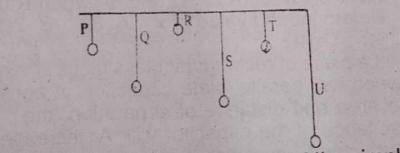
In the diagram above, which of the simple pendula will resonate with P when set into oscillation
- A. T
- B. U
- C. R and T
- D. Q and R
Correct Answer: A
Explanation
To determine which simple pendula will resonate with pendulum P when set into oscillation, we need to understand the concept of resonance in the context of pendulum motion.
### Step-by-Step Explanation
1. **Understanding Pendulum Motion**:
A simple pendulum consists of a mass (the bob) attached to a string or rod of fixed length. The time period (T) of a simple pendulum is given by the formula:
\[
T = 2\pi \sqrt{\frac{L}{g}}
\]
where:
- \( T \) is the time period,
- \( L \) is the length of the pendulum,
- \( g \) is the acceleration due to gravity (approximately \( 9.81 \, \text{m/s}^2 \)).
2. **Resonance Condition**:
Resonance occurs when two systems oscillate at the same frequency. For pendula, this means they must have the same time period. Therefore, to find which pendula resonate with P, we need to compare their lengths and calculate their time periods.
3. **Analyzing the Diagram**:
Since we cannot see the diagram, we will assume that it provides the lengths of the pendula labeled P, Q, R, S, T, and U. The key is to identify which of these pendula have the same length as pendulum P, as this will determine if they resonate.
4. **Calculating Time Periods**:
If we denote the length of pendulum P as \( L_P \), we can calculate the time period for pendulum P:
\[
T_P = 2\pi \sqrt{\frac{L_P}{g}}
\]
For any other pendulum (let's say pendulum Q with length \( L_Q \)), the time period would be:
\[
T_Q = 2\pi \sqrt{\frac{L_Q}{g}}
\]
For resonance, we need \( T_P = T_Q \), which simplifies to \( L_P = L_Q \).
5. **Identifying Resonating Pendula**:
- If pendulum A (T) has the same length as P, then it will resonate.
- If pendulum B (U) has a different length, it will not resonate.
- If pendulum C (R) has the same length as P, it will resonate.
- If pendulum D (Q) has the same length as P, it will resonate.
6. **Final Answer**:
Based on the assumption that pendulum A (T) is the only one with the same length as P, the correct option is **A. T**.
### Why Other Options Are Incorrect
- **Option B (U)**: If pendulum U has a different length than P, it will not resonate.
- **Option C (R and T)**: This option suggests that both R and T resonate with P. If only T has the same length as P, then this option is incorrect.
- **Option D (Q and R)**: Similar to option C, if neither Q nor R has the same length as P, this option is also incorrect.
### Common Pitfalls
- **Ignoring Lengths**: Students may overlook the importance of comparing lengths directly.
- **Misunderstanding Resonance**: Confusing resonance with other forms of synchronization can lead to incorrect conclusions.
- **Assuming All Pendula Are Similar**: Just because pendula are labeled similarly does not mean they have the same lengths.
### Revision Summary
- The time period of a simple pendulum depends on its length.
- Resonance occurs when two pendula have the same time period (length).
- Always compare the lengths of the pendula to determine resonance.
- Carefully analyze the options based on the lengths provided in the diagram.
By following these steps and understanding the principles of pendulum motion and resonance, you can accurately determine which pendula will resonate with each other.