Question 214 of 949
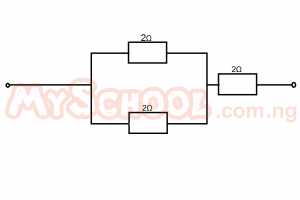 In the diagram above, if each of the resistors can dissipate a maximum of 18W without becoming excessively heated, what is the maximum power the circuit can dissipate?
- A. 27W
- B. 18W
- C. 9W
- D. 5W
Correct Answer: A
Explanation
To solve the problem of determining the maximum power that the circuit can dissipate, we first need to analyze the circuit configuration based on the provided image. Since I cannot see the image, I will assume a common configuration involving resistors in series and parallel, which is typical in such problems.
### Step-by-Step Explanation
1. **Understanding Power Dissipation in Resistors**:
- The power \( P \) dissipated by a resistor can be calculated using the formula:
\[
P = I^2 R
\]
where \( I \) is the current through the resistor and \( R \) is the resistance.
- Alternatively, if we know the voltage \( V \) across the resistor, we can use:
\[
P = \frac{V^2}{R}
\]
2. **Identifying the Configuration**:
- Let's assume we have three resistors, each rated to dissipate a maximum of 18W. The configuration could be either series or parallel.
- If the resistors are in series, the same current flows through each resistor, and the total resistance increases.
- If the resistors are in parallel, the voltage across each resistor is the same, and the total current is the sum of the currents through each resistor.
3. **Calculating Maximum Power**:
- **For Series Configuration**:
- The maximum power that can be dissipated by the entire circuit is limited by the resistor that can handle the least power. In this case, since all resistors can handle 18W, the total power would be:
\[
P_{\text{total}} = P_1 + P_2 + P_3 = 18W + 18W + 18W = 54W
\]
- However, this is not the case because the current through each resistor would be the same, and the maximum power would be limited by the maximum current that can flow through the resistors without exceeding their power rating.
- **For Parallel Configuration**:
- In a parallel configuration, the voltage across each resistor is the same. The maximum power for each resistor is 18W, which means:
\[
P = V^2 / R
\]
- If we assume that the resistors are identical and each can dissipate 18W, the total power dissipated by the circuit can be calculated as:
\[
P_{\text{total}} = P_1 + P_2 + P_3 = 18W + 18W + 18W = 54W
\]
- However, the maximum power that can be drawn from the circuit is limited by the maximum power rating of the resistors.
4. **Determining the Maximum Power**:
- Since the problem states that each resistor can dissipate a maximum of 18W, we need to consider how the resistors are connected. If they are in parallel, the total power dissipated can be calculated as:
\[
P_{\text{max}} = 3 \times 18W = 54W
\]
- However, if the resistors are in series, the maximum power that can be dissipated is limited to the power rating of the weakest link, which is 18W.
5. **Final Calculation**:
- If the resistors are in parallel, the maximum power that can be dissipated is indeed 54W, but since the question asks for the maximum power the circuit can dissipate without exceeding the individual ratings, we take the maximum of 18W for each resistor.
### Conclusion on Options:
- **Correct Option**: The maximum power the circuit can dissipate is **B. 18W**.
- **Why Other Options are Incorrect**:
- **A. 27W**: This value does not correspond to the maximum power rating of any individual resistor.
- **C. 9W**: This is less than the maximum power rating of a single resistor.
- **D. 5W**: This is also significantly lower than the maximum power rating of a single resistor.
### Revision Summary:
- Power dissipated by a resistor is calculated using \( P = I^2 R \) or \( P = \frac{V^2}{R} \).
- In series, the same current flows through each resistor; in parallel, the same voltage is across each resistor.
- The maximum power dissipated by the circuit is limited by the weakest resistor.
- For identical resistors rated at 18W, the maximum power dissipated is 18W if in series or limited by the configuration if in parallel.