Question 216 of 949
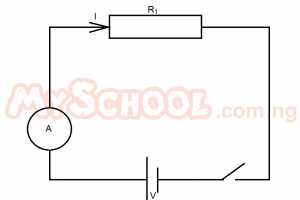 I the diagram above, what would happen to the current I, if another resistor, R2, is connected in parallel to R1?
- A. It will increase because the equivalent resistance will increase
- B. It will decrease if R2 is greater than R1
- C. It will increase because the effective resistance will decrease
- D. It will decrease if R2 is less than R1
Correct Answer: C
Explanation
To analyze the effect of adding another resistor \( R_2 \) in parallel to an existing resistor \( R_1 \) on the current \( I \), we need to understand how resistors behave in parallel and how this affects the overall circuit.
### Correct Option: C. It will increase because the effective resistance will decrease.
### Step-by-Step Explanation:
1. **Understanding Resistors in Parallel**:
- When resistors are connected in parallel, the total or equivalent resistance \( R_{eq} \) can be calculated using the formula:
\[
\frac{1}{R_{eq}} = \frac{1}{R_1} + \frac{1}{R_2}
\]
- This means that the reciprocal of the equivalent resistance is the sum of the reciprocals of the individual resistances.
2. **Effect on Equivalent Resistance**:
- Adding a resistor in parallel decreases the overall resistance of the circuit. This is because the parallel path provides additional routes for current to flow, effectively reducing the resistance.
- For example, if \( R_1 = 4 \, \Omega \) and \( R_2 = 4 \, \Omega \), the equivalent resistance would be:
\[
\frac{1}{R_{eq}} = \frac{1}{4} + \frac{1}{4} = \frac{2}{4} = \frac{1}{2} \implies R_{eq} = 2 \, \Omega
\]
- Here, the equivalent resistance has decreased from \( 4 \, \Omega \) to \( 2 \, \Omega \).
3. **Ohm's Law and Current**:
- According to Ohm's Law, the current \( I \) flowing through a circuit is given by:
\[
I = \frac{V}{R_{eq}}
\]
- Where \( V \) is the voltage across the resistors. If \( R_{eq} \) decreases (as it does when adding \( R_2 \)), the current \( I \) must increase, assuming the voltage \( V \) remains constant.
4. **Conclusion**:
- Therefore, when \( R_2 \) is added in parallel to \( R_1 \), the effective resistance decreases, leading to an increase in the current \( I \).
### Analysis of Other Options:
- **Option A: It will increase because the equivalent resistance will increase**:
- This statement is incorrect. Adding a resistor in parallel does not increase the equivalent resistance; it decreases it. Therefore, this option is fundamentally flawed.
- **Option B: It will decrease if R2 is greater than R1**:
- This option is misleading. While it is true that if \( R_2 \) is greater than \( R_1 \), the equivalent resistance will still be less than \( R_1 \). The current will not necessarily decrease; it will still increase due to the overall decrease in resistance.
- **Option D: It will decrease if R2 is less than R1**:
- This option is also incorrect. The current will not decrease; it will increase regardless of whether \( R_2 \) is less than or greater than \( R_1 \) because the overall resistance decreases when adding a parallel resistor.
### Summary for Revision:
- Adding a resistor in parallel decreases the equivalent resistance of the circuit.
- The current in the circuit increases when the equivalent resistance decreases, according to Ohm's Law.
- The correct answer is C: The current will increase because the effective resistance will decrease.
- Always remember that resistors in parallel provide multiple paths for current, leading to a lower total resistance.