Question 225 of 480
Mathematics
JAMB 2004
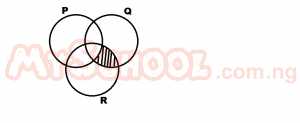
The shaded region in the Venn diagram above is
- A. Pc ∪ (Q ∩ R)
- B. Pc ∩ (Q ∪ R)
- C. P ∩ Q
- D. Pc ∩ (Q ∩ R)
Correct Answer: D
Explanation
To solve the problem regarding the shaded region in the Venn diagram, we need to analyze the options provided and understand the notation used in set theory.
### Step-by-Step Explanation
1. **Understanding the Venn Diagram**:
- A Venn diagram typically represents different sets and their relationships. In this case, we have three sets: P, Q, and R.
- The notation \( P^c \) (read as "P complement") refers to all elements that are **not** in set P.
- The intersection symbol \( \cap \) represents elements that are common to both sets.
- The union symbol \( \cup \) represents all elements that are in either set.
2. **Analyzing the Options**:
- **Option A: \( P^c \cup (Q \cap R) \)**: This represents all elements that are either not in P or are in both Q and R. This does not accurately describe the shaded area if it is only the intersection of Q and R.
- **Option B: \( P^c \cap (Q \cup R) \)**: This represents elements that are not in P and are either in Q or R. This does not match the shaded area if it includes elements from P.
- **Option C: \( P \cap Q \)**: This represents elements that are in both P and Q. This does not include any elements from R or the complement of P, so it is not the shaded area if it includes elements outside of P.
- **Option D: \( P^c \cap (Q \cap R) \)**: This represents elements that are not in P and are also in both Q and R. If the shaded area is specifically the intersection of Q and R while excluding P, this option accurately describes that area.
3. **Why Option D is Correct**:
- The shaded region is defined as the area that includes elements from both Q and R but excludes any elements from P. Therefore, we are looking for elements that are in the intersection of Q and R while also being outside of P.
- Mathematically, this is expressed as \( P^c \cap (Q \cap R) \), which means we are taking the intersection of the complement of P with the intersection of Q and R.
4. **Why Other Options are Incorrect**:
- **Option A** includes elements that are not in P or are in both Q and R, which could include elements outside the intersection of Q and R.
- **Option B** includes elements that are not in P but could be in either Q or R, which does not restrict to the intersection of Q and R.
- **Option C** only considers elements in P and Q, ignoring R entirely and does not account for the complement of P.
### Summary of Key Points
- **Venn Diagram Basics**: Understand the meaning of union, intersection, and complement.
- **Set Notation**: Familiarize yourself with how to read and interpret set notation.
- **Shaded Region Analysis**: Identify what the shaded area represents in terms of set operations.
- **Correct Option**: The correct answer is D, as it accurately describes the shaded area as elements in both Q and R while excluding P.
### Revision Summary
- **Venn Diagrams** represent relationships between sets using intersections and unions.
- **Set Complement** indicates elements not in a specified set.
- **Intersection** focuses on common elements between sets.
- **Correct Answer**: D is correct because it captures the essence of the shaded area as elements in Q and R but not in P.