Transport System
1. Introduction to Transport Systems
Transport systems are essential in living organisms to ensure the movement of materials such as nutrients, gases, water, and waste products to and from cells for survival. These systems adapt to organism size and complexity.
Need for Transport
- Surface Area-to-Volume Ratio
- As organisms grow larger, their surface area-to-volume ratio decreases, making diffusion alone insufficient for material exchange.
- Example: Unicellular organisms rely on diffusion, but in multicellular organisms, transport systems are required to overcome the limitations of diffusion.
- Long-Distance Movement
- Larger organisms need specialized systems for transporting substances over greater distances.
- Example: Blood circulatory system in animals and vascular tissues in plants.
2. Transport in Animals
(a) Structure of the Circulatory System
-
Heart
- A muscular organ that pumps blood throughout the body.
- Structure: Four chambers in humans (2 atria, 2 ventricles).
- Function: Maintains unidirectional flow and pressure for circulation.
- Diagram: A labeled diagram of the human heart with major blood vessels.
-
Arteries, Veins, and Capillaries
- Arteries: Thick-walled vessels carrying blood away from the heart.
- Veins: Thin-walled vessels returning blood to the heart, often with valves.
- Capillaries: Tiny, thin-walled vessels facilitating material exchange with tissues.
(b) Composition and Function of Blood and Lymph
-
Blood:
- Components: Red blood cells (RBCs), white blood cells (WBCs), platelets, and plasma.
- Functions: Transport gases, nutrients, hormones, and waste products; immune defense; clotting.
-
Lymph:
- Composition: Interstitial fluid rich in white blood cells.
- Functions: Immune defense and return of fluid to the blood.
(c) Materials for Transport
- Excretory Products: Urea transported to kidneys for excretion.
- Gases: Oxygen transported by hemoglobin; carbon dioxide transported as bicarbonate.
- Digested Food and Nutrients: Absorbed in the intestines and distributed via the bloodstream.
3. Transport in Plants
(a) Uptake and Movement of Water and Mineral Salts
-
Uptake from Soil:
- Roots absorb water and minerals through root hairs via osmosis and active transport.
- Experiment: Eosin solution uptake demonstrating water transport pathways.
-
Movement Through the Plant:
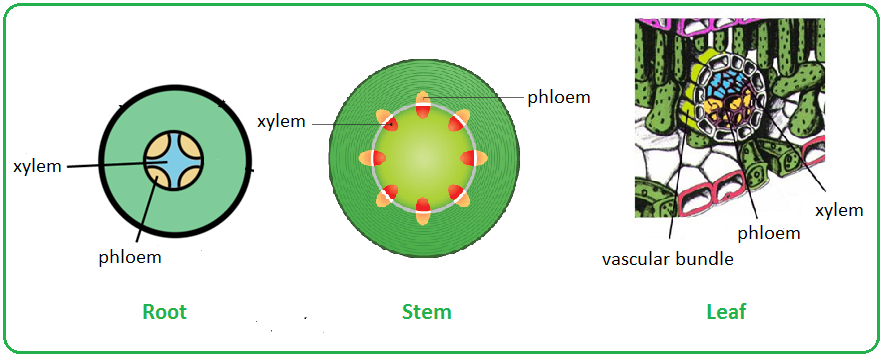
- Xylem vessels transport water and dissolved minerals upward to leaves.
(b) Translocation
- Movement of organic materials (e.g., sugars) from leaves to other plant parts through phloem.
- Pressure Flow Hypothesis: Suggests that sucrose is actively loaded into phloem, generating osmotic pressure to drive flow.
(c) Transpiration
- Definition: Loss of water vapor from aerial parts of plants, primarily through stomata.
- Types:
- Stomatal, cuticular, and lenticular transpiration.
- Factors Affecting Transpiration:
- Environmental: Light, temperature, humidity, and wind speed.
- Physiological: Number and distribution of stomata.
- Advantages: Cooling effect, nutrient transport.
- Disadvantages: Risk of water loss and wilting.
(d) Movement of Water to the Apex of Trees
-
Mechanisms:
- Root Pressure: Upward push of water from roots.
- Cohesion-Tension Mechanism: Water molecules stick together (cohesion) and adhere to xylem walls, pulled upward by transpiration.
-
Experiment:
- Ringing experiment shows that phloem transports organic nutrients, while xylem transports water and minerals.
4. Media of Transport
- In Plants: Cytoplasm, cell sap, xylem sap, phloem sap.
- In Animals: Blood, lymph, and body fluids in invertebrates.
5. Circulatory Systems in Animals
- Open Circulatory System: Blood flows freely in body cavities (e.g., insects).
- Closed Circulatory System: Blood confined to vessels (e.g., vertebrates).
6. Real-World Applications
- Medical Field: Understanding circulatory disorders (e.g., hypertension, anemia).
- Agriculture: Enhancing water and nutrient uptake in crops.
7. Common Misconceptions
- Transpiration is always harmful: While excessive transpiration can cause wilting, it aids nutrient transport and cooling.
- Plants do not require transport systems: Even though plants lack a heart, xylem and phloem serve as effective transport networks.
8. Summary
- Efficient transport systems overcome limitations of diffusion in multicellular organisms.
- In animals, the circulatory system ensures material transport through blood and lymph.
- In plants, xylem, phloem, and associated processes like transpiration and translocation enable nutrient and water transport.
- Experiments like the eosin solution and ringing experiment illustrate these processes.
Formulas and Equations:
- Water Potential (Ψ\PsiΨ): Ψ=Ψs+Ψp\Psi = \Psi_s + \Psi_pΨ=Ψs+Ψp
- Transpiration Rate: Rate=Water lossTime\text{Rate} = \frac{\text{Water loss}}{\text{Time}}Rate=TimeWater loss
Key Diagram Suggestions:
- Labeled human heart and blood vessels.


2. Xylem and phloem cross-section in plants.