Transmission and expression of characteristics in organisms.
Transmission and Expression of Characteristics in Organisms
Introduction to Hereditary Variation
Hereditary variation refers to the differences in traits that are passed from parents to offspring through genes. It is the basis for the diversity of life and enables species to adapt to changing environments.
Key Concepts
- Traits: Observable characteristics such as eye color, height, or flower color.
- Genes: Units of heredity located on chromosomes, responsible for the transmission of traits.
- Alleles: Different versions of a gene, e.g., for flower color in peas, alleles might determine red or white flowers.
- Genotype and Phenotype:
- Genotype: The genetic makeup of an organism (e.g., RR, Rr, or rr for flower color).
- Phenotype: The observable traits expressed (e.g., red flowers or white flowers).
Mendel's Work in Genetics
Gregor Mendel, the "Father of Genetics," laid the foundation for understanding heredity by experimenting with pea plants (Pisum sativum). His work led to the formulation of key genetic principles.
Mendel's Experiments
-
Selection of Pea Plants:
- Mendel chose pea plants due to their distinct, easily observable traits (e.g., flower color, seed shape).
- Pea plants are also capable of both self-pollination and cross-pollination.
-
Monohybrid Cross:
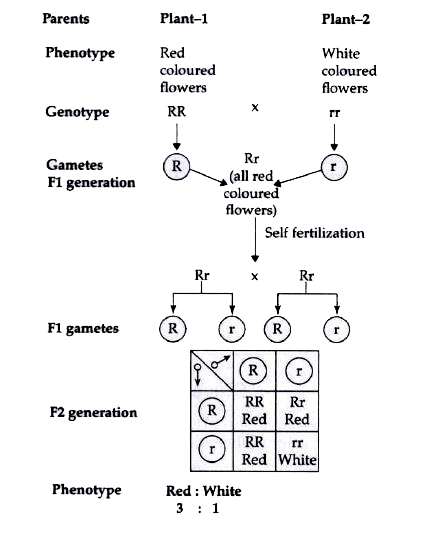
- Experiment: Mendel crossed a pure-breeding red-flowered pea plant (RR) with a white-flowered one (rr).
- Observations:
- First Generation (F₁): All plants had red flowers.
- Second Generation (F₂): The plants displayed a 3:1 ratio (3 red:1 white).
- Explanation:
- Red (R) is the dominant allele.
- White (r) is the recessive allele.
-
Dihybrid Cross:
- Experiment: Mendel crossed plants with two differing traits, such as seed shape (round or wrinkled) and color (yellow or green).
- Observations:
- F₂ generation displayed a 9:3:3:1 phenotypic ratio.
- This demonstrated the independent assortment of traits.
Mendelian Traits
Traits governed by single genes with clear dominant and recessive alleles are termed Mendelian traits.
- Examples in Plants:
- Dominant: Red flower color, tall stem.
- Recessive: White flower color, short stem.
- Examples in Animals:
- Dominant: Brown eyes in humans.
- Recessive: Blue eyes in humans.
Mendelian Laws
-
Law of Segregation:
- Every organism carries two alleles for each trait, which segregate during gamete formation. Each gamete gets one allele.
- Example: A heterozygous pea plant (Rr) produces two types of gametes: R and r.
-
Law of Independent Assortment:
- Alleles of different traits assort independently during gamete formation.
- Example: Seed shape (round or wrinkled) and color (yellow or green) are inherited independently.
-
Law of Dominance:
- In a heterozygous organism, the dominant allele masks the expression of the recessive allele.
Real-World Applications
- Agriculture:
- Breeding high-yield crops with desirable traits, e.g., disease resistance.
- Medicine:
- Understanding genetic diseases and inheritance patterns, e.g., cystic fibrosis (recessive inheritance).
- Genetic Engineering:
- Modifying genes to improve organisms (e.g., genetically modified crops).
Common Misconceptions
- All traits are Mendelian:
- Many traits, like height or skin color, are polygenic and do not follow Mendelian ratios.
- Dominant traits are superior:
- Dominance relates to gene expression, not the trait's "value" or "strength."
Summary Diagram
Monohybrid Cross Example
- Parental Generation (P): RR (red) × rr (white)

- F₁: 100% Rr (red)

F₂: 75% red (RR, Rr), 25% white (rr)
Dihybrid Cross Example
- Traits: Seed shape (round vs. wrinkled), Seed color (yellow vs. green)

- F₂ Phenotypic Ratio: 9:3:3:1
Illustration: A Punnett square for monohybrid and dihybrid crosses (to visualize ratios).
This structured understanding of hereditary variation and Mendelian genetics is fundamental to biology, with implications ranging from agriculture to healthcare.