Tissues and supporting systems: in animals and plants.
1. Tissues and Supporting Systems: Skeleton and Supporting Systems in Animals
1.1 Biological Significance of Skeletons
- Definition: The skeleton is a framework that provides structure and support to the body of an organism.
- Significance:
- Supports the body’s shape and form.
- Facilitates movement in conjunction with muscles.
- Protects vital organs (e.g., skull protects the brain, ribcage protects the heart and lungs).
- Assists in respiratory movements (e.g., rib cage expands during breathing).
1.2 Skeletal Materials
-
Bone:
- Features: Hard, rigid, and mineralized tissue composed primarily of calcium phosphate.
- Function: Provides structural support, protection, and storage of minerals.
- Example: Femur (thigh bone).
-
Cartilage:
- Features: Flexible, elastic tissue made of chondrocytes and collagen.
- Function: Reduces friction at joints, provides flexibility and cushioning.
- Example: Ear cartilage.
-
Chitin:
- Features: Tough, fibrous polysaccharide found in invertebrates.
- Function: Forms exoskeletons in arthropods like insects and crustaceans.
- Example: Shell of a crab.
1.3 Types of Skeletons
-
Exoskeleton:
- External hard covering.
- Found in arthropods (e.g., insects, crabs).
- Provides protection and prevents water loss.
-
Endoskeleton:
- Internal skeletal structure.
- Found in vertebrates (e.g., humans, fish).
- Supports the body internally and facilitates movement.
-
Hydrostatic Skeleton:
- Fluid-filled cavities that provide support.
- Found in soft-bodied animals like earthworms and jellyfish.
- Facilitates movement by changing the shape of the body.
1.4 Bones of the Vertebral Column, Girdles, and Appendicular Skeleton
-
Vertebral Column:
- Divided into cervical, thoracic, lumbar, sacral, and coccygeal regions.
- Protects the spinal cord and supports body weight.
-
Girdles:
- Pectoral Girdle: Connects forelimbs to the axial skeleton.
- Pelvic Girdle: Connects hind limbs to the axial skeleton.
-
Long Bones:
- Found in the appendicular skeleton (e.g., humerus, femur).
- Facilitate locomotion and movement.
1.5 Mechanism of Support in Animals
- The skeleton provides a rigid framework for muscles to attach.
- Muscles contract to move bones at joints, enabling locomotion and flexibility.
1.6 Functions of Skeleton in Animals
- Protection: Shields delicate organs (e.g., skull protects the brain).
- Support: Maintains the body’s shape and posture.
- Locomotion: Works with muscles to enable movement.
- Respiratory Movement: Facilitates breathing through the expansion and contraction of the rib cage.
2. Supporting Tissues in Plants
2.1 Main Features of Supporting Tissues in Plants
-
Turgid Parenchyma:
- Living cells with thin walls.
- Store water and nutrients, contributing to turgidity and support.
-
Collenchyma:
- Living cells with thickened cell walls at corners.
- Provide flexibility and mechanical support.
-
Sclerenchyma:
- Dead cells with lignified walls.
- Offer rigidity and strength.
-
Xylem (Wood):
- Conducts water and minerals.
- Provides mechanical support through lignified tissue.
2.2 Functions of Supporting Tissues in Plants
- Strength and Rigidity:
- Prevent collapse against external forces like wind and water.
- Flexibility:
- Allow bending without breaking (e.g., collenchyma).
- Resilience:
- Enable recovery after stress.
3. Location and Arrangement of Skeletal and Supporting Tissues
3.1 In Animals:
- Bones are strategically located to support the body's framework.
- Cartilage is found in joints, ear, nose, and intervertebral discs.
- Chitin forms the exoskeleton in arthropods.
3.2 In Plants:
- Supporting tissues are distributed throughout the stem, roots, and leaves.
- Epidermis: Protects the plant’s outer surface.
- Cortex: Provides support and storage.
- Stele: Contains vascular tissues (xylem and phloem).
4. Real-World Applications
-
Skeletal System in Medicine:
- Bone grafts and cartilage repair for injuries.
- Artificial joints for mobility restoration.
-
Plant Supporting Tissues in Agriculture:
- Enhancing crop resilience against environmental stressors.
5. Common Misconceptions
- Misconception: "All skeletons are made of bone."
- Fact: Exoskeletons and hydrostatic skeletons are made of other materials like chitin or fluid-filled structures.
- Misconception: "Plants do not have structural support systems."
- Fact: Supporting tissues like sclerenchyma and collenchyma provide rigidity and flexibility.
6. Key Diagrams
-
Skeleton of a Mammal:
- Label vertebral column, girdles, and long bones.


-
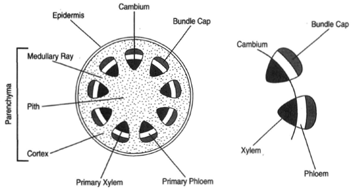
T.S. of Herbaceous Plant Stem:
- Include labeled sections of epidermis, cortex, and stele.

Summary
- Skeletons in animals provide protection, support, and locomotion, while supporting tissues in plants ensure rigidity, flexibility, and resilience.
- Understanding the interplay between structure and function in these systems highlights their critical role in survival and adaptability.