Sense Organs: Structure and function
Sense organs are specialized structures that detect and respond to stimuli, allowing organisms to interact with their environment. This note focuses on the structure and function of two major sense organs in mammals: the eye and the ear.
A. The Eye: Structure and Function
The eye is a complex organ that detects light and enables vision. It is spherical in shape, encased within the skull for protection, and connected to the brain via the optic nerve.
1. External Features of the Eye
- Shape: Nearly spherical.
- Color: The sclera (white of the eye) is white; the iris (colored part) varies in color.
- Position: The eyes are located in the orbits of the skull, held in place by muscles and connective tissue.
- Optic Muscles: Six muscles control eye movement in various directions.
- Optic Nerve: A thick nerve at the back of the eye transmits visual information to the brain.
2. Structure of the Eye
The eye consists of three main layers and other specialized structures:
(a) Outer Layer
- Sclera: Tough, protective outer layer.
- Cornea: Transparent, curved front part that refracts light into the eye.
(b) Middle Layer (Uvea)
- Choroid: Vascular layer supplying nutrients and oxygen.
- Iris: Colored part, controlling the size of the pupil.
- Pupil: Opening that regulates the amount of light entering the eye.
(c) Inner Layer
- Retina: Contains photoreceptor cells (rods for dim light, cones for color vision).
Other Key Structures
- Lens: Biconvex, transparent structure focusing light onto the retina.
- Aqueous and Vitreous Humor: Clear fluids that maintain the shape of the eye and refract light.
- Fovea: Part of the retina with a high concentration of cones for sharp vision.
3. Function of the Eye
- Light enters the eye through the cornea and pupil.
- The lens focuses light onto the retina, forming an inverted image.
- Photoreceptors in the retina convert light into electrical signals.
- The optic nerve transmits signals to the brain for interpretation.
4. Eye Defects and Their Corrections
- Myopia (Short-sightedness): Difficulty seeing distant objects; corrected with concave lenses.
- Hyperopia (Long-sightedness): Difficulty seeing close objects; corrected with convex lenses.
- Astigmatism: Irregular curvature of the cornea; corrected with cylindrical lenses.
- Cataracts: Clouding of the lens; treated surgically by replacing the lens.
5. Real-World Applications
- Eyeglasses and Contact Lenses: Correct vision defects.
- Optical Devices: Cameras mimic the eye’s focusing mechanism.
B. The Ear: Structure and Function
The ear is a sensory organ responsible for hearing and balance. It consists of three main parts: the outer ear, middle ear, and inner ear.
1. External Features of the Ear
- Shape: Pinna (visible part) is funnel-shaped.
- Color: Skin-covered cartilage.
- Position: Located symmetrically on either side of the head.
2. Structure of the Ear
(a) Outer Ear
- Pinna: Collects sound waves.
- Auditory Canal: Directs sound waves to the eardrum.
- Tympanic Membrane (Eardrum): Vibrates in response to sound waves.
(b) Middle Ear
- Ossicles: Three tiny bones (malleus, incus, stapes) amplify vibrations.
- Eustachian Tube: Equalizes air pressure on both sides of the eardrum.
(c) Inner Ear
- Cochlea: Spiral structure containing hair cells that convert vibrations into electrical signals.
- Semicircular Canals: Detect head movement and maintain balance.
- Auditory Nerve: Carries sound signals to the brain.
3. Function of the Ear
- Sound waves are collected by the pinna and funneled into the auditory canal.
- Vibrations from the eardrum are amplified by the ossicles.
- The cochlea converts these vibrations into nerve impulses, which are transmitted to the brain.
4. Common Hearing Disorders
- Hearing Loss: Caused by damage to hair cells or the auditory nerve.
- Tinnitus: Perception of ringing sounds without external stimuli.
5. Real-World Applications
- Hearing Aids: Amplify sound for those with hearing impairments.
- Cochlear Implants: Directly stimulate the auditory nerve in cases of severe hearing loss.
Summary Table
| Feature | The Eye | The Ear |
|---|---|---|
| Function | Vision (light detection) | Hearing and balance |
| Main Structures | Cornea, lens, retina, optic nerve | Cochlea, semicircular canals, auditory nerve |
| Defects | Myopia, hyperopia, astigmatism | Hearing loss, tinnitus |
| Applications | Glasses, contact lenses | Hearing aids, cochlear implants |
Conclusion
The eye and ear are remarkable organs that allow humans to interact with their environment through sight and sound. Understanding their structure and function helps in diagnosing and treating related defects, improving quality of life.
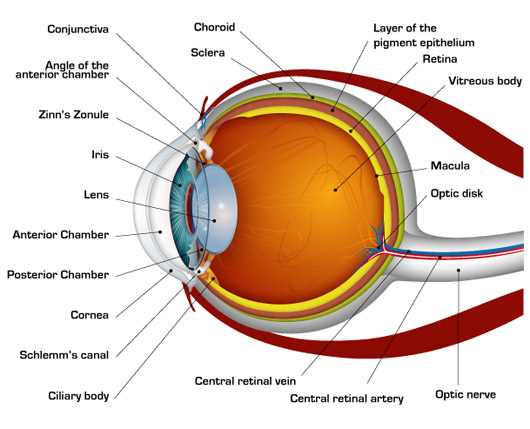 The Eye
The Ear