Regulation of Internal Environment (Homeostasis)
Regulation of Internal Environment (Homeostasis)
Homeostasis is the process by which organisms maintain a stable internal environment despite changes in external conditions. This regulation is critical for optimal cellular function and overall health.
1. Kidney: Structure and Functions
1.1 Structure of the Kidney
- Overview: The kidney is a bean-shaped organ located in the abdominal cavity, with one on each side of the vertebral column.
- Major parts:
- Cortex: The outer region, containing the glomeruli and Bowman’s capsules.
- Medulla: The inner region, containing the loops of Henle and collecting ducts.
- Renal pelvis: Funnel-like structure that collects urine and connects to the ureter.
- Nephrons: Functional units of the kidney, responsible for filtration and excretion.
Diagram of the Kidney
A labeled diagram should include the cortex, medulla, renal artery, renal vein, ureter, and nephron.

1.2 Functions of the Kidney
- Filtration: Removal of waste products and excess substances from blood in the glomerulus.
- Example: Filtration of urea, a nitrogenous waste product.
- Reabsorption: Recovery of essential nutrients and water from the filtrate into the blood.
- Example: Reabsorption of glucose in the proximal tubule.
- Excretion: Removal of metabolic wastes such as urea, salts, and water in the form of urine.
- Osmoregulation: Maintenance of water and salt balance in the body.
- Example: Adjusting water reabsorption in the collecting ducts under the influence of antidiuretic hormone (ADH).
- Acid-Base Balance: Regulation of blood pH by excreting hydrogen ions and reabsorbing bicarbonate.
1.3 Factors Affecting Kidney Function
- Water and salt content of blood: High salt levels trigger increased water reabsorption to dilute salts.
- Environmental temperature: High temperatures increase water loss through sweat, affecting urine concentration.
2. Liver: Functions
2.1 Structure and Position
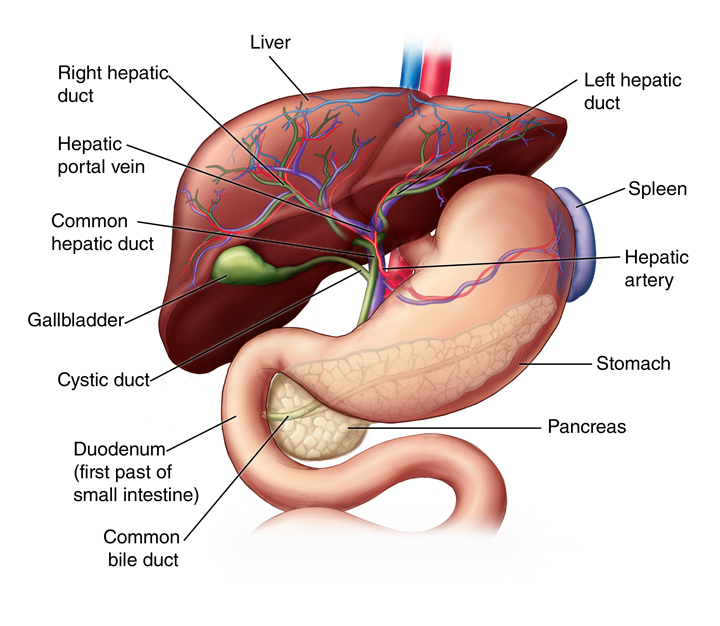
- Located in the upper right quadrant of the abdomen, the liver lies just below the diaphragm.
- Nearby structures:
- Gallbladder: Stores bile produced by the liver.
- Bile duct: Transports bile to the duodenum.
- Pancreas and stomach: Located adjacent to the liver.
Diagram of the Liver
A labeled diagram should show the liver, gallbladder, bile duct, pancreas, stomach, and duodenum.
2.2 Functions of the Liver
- Detoxification: Breaks down harmful substances such as alcohol and drugs.
- Production of bile: Aids in the emulsification of fats during digestion.
- Storage: Stores glycogen, vitamins (A, D, B12), and minerals (iron, copper).
- Metabolism:
- Converts glucose to glycogen (glycogenesis) and vice versa (glycogenolysis).
- Deaminates amino acids, forming urea as a by-product.
- Synthesis:
- Produces plasma proteins like albumin and clotting factors.
- Synthesizes cholesterol.
3. The Skin: Structure and Functions
3.1 Structure of the Skin
- Epidermis: The outermost layer; provides a barrier and prevents water loss.
- Dermis: Middle layer; contains sweat glands, sebaceous glands, blood vessels, and sensory receptors.
- Hypodermis: Deepest layer; composed of fat and connective tissue for insulation and energy storage.
Diagram of Mammalian Skin
A labeled diagram should include the epidermis, dermis, sweat glands, sebaceous glands, blood vessels, hair follicles, and nerves.

3.2 Functions of the Skin
- Osmoregulation:
- Regulates water loss through sweat.
- Maintains hydration by controlling trans-epidermal water loss.
- Excretion: Removes urea, salts, and water via sweat.
- Thermoregulation:
- Cooling: Sweating and vasodilation.
- Warming: Vasoconstriction and piloerection.
- Acid-Base Balance: Slightly acidic sweat helps in maintaining the pH of the skin.
4. Regulation of Internal Environment
4.1 Osmoregulation
- Maintained by the kidney, skin, and hormonal control (e.g., ADH and aldosterone).
- Example: In dehydration, ADH increases water reabsorption in the kidneys.
4.2 Excretion
- Involves the removal of metabolic wastes:
- Urea: Produced in the liver from amino acid deamination.
- Water and salts: Excreted by the kidneys and skin.
- Uric acid: A by-product of nucleic acid metabolism.
4.3 Maintenance of Acid-Base Balance
- Kidneys excrete hydrogen ions and reabsorb bicarbonate to stabilize blood pH.
- Example: In acidosis, kidneys increase hydrogen ion excretion.
5. Real-World Applications and Misconceptions
Applications
- Dialysis: Artificial kidney function for patients with renal failure.
- Liver transplants: Treatment for severe liver diseases.
- Skin grafts: Used in treating burns and injuries.
Misconceptions
- "Sweat is only water": Sweat contains salts and urea.
- "The liver only digests food": It has metabolic, detoxifying, and synthetic functions.
By understanding the regulation of the internal environment, we appreciate the body's remarkable ability to maintain stability and adapt to changes, ensuring survival and health.