Organization of life
Organization of Life: Levels and Complexity
Understanding the organization of life is fundamental to biology. Organisms display a hierarchical structure ranging from simple unicellular organisms to complex multicellular systems. Each level demonstrates increasing complexity and specialization, which are key to efficient functioning and survival.
(a) Levels of Organization
The biological organization progresses from cells to systems, with increasing complexity at each level.
(i) Cell (Single-Celled Organisms)
Definition:
- The cell is the basic unit of life, capable of performing all life processes.
- Single-celled organisms function independently, with the single cell performing all essential roles such as metabolism, reproduction, and locomotion.
Examples:
- Amoeba:
- Movement: Pseudopodia (extensions of the cell membrane).
- Function: Engulfs food via phagocytosis.
- Euglena:
- Features: Contains chloroplasts for photosynthesis and flagella for movement.
- Dual Nutrition: Can photosynthesize or consume food heterotrophically.
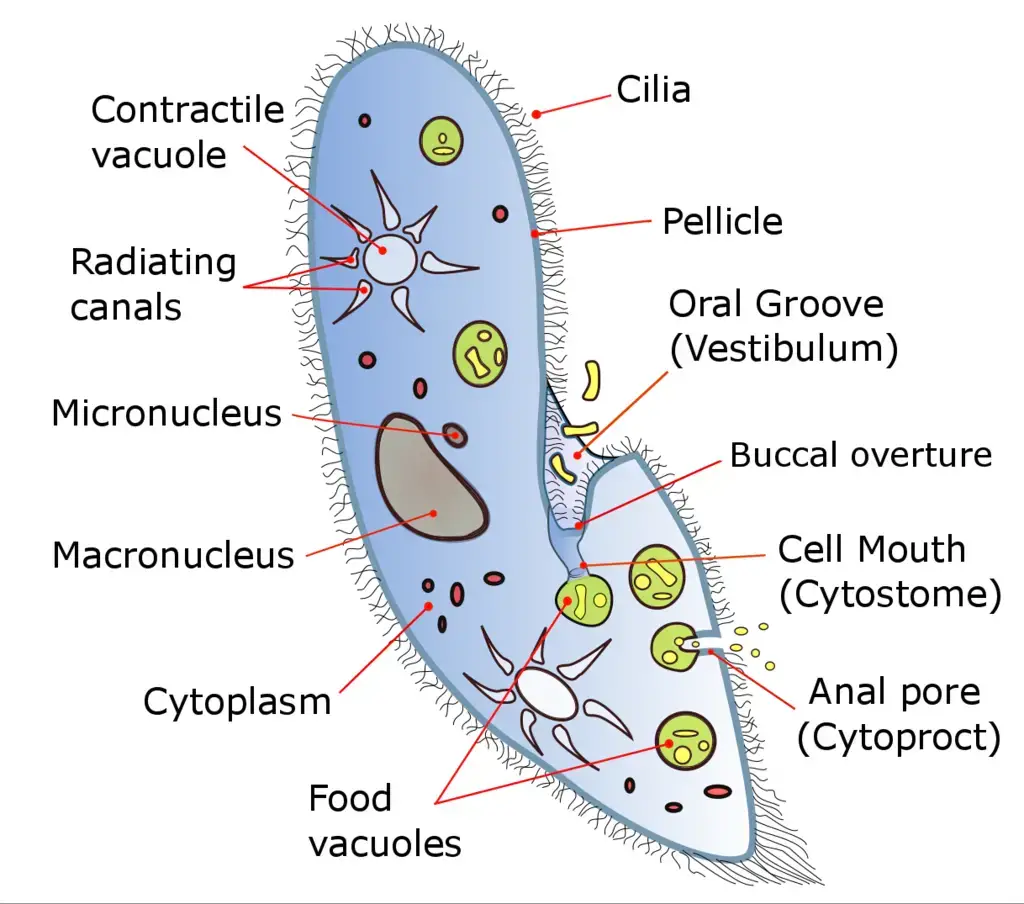
- Paramecium:
- Movement: Cilia for locomotion.
- Function: Specialized feeding structure called the oral groove.
Key Points:
- Single-celled organisms illustrate differentiation within a single cell, allowing them to perform complex functions independently.
(ii) Tissue (Example: Hydra)
Definition:
- A tissue is a group of similar cells working together to perform a specific function.
- In multicellular organisms, tissues form the next level of organization.
Example: Hydra
- Structure: Composed of two layers of cells (ectoderm and endoderm).
- Differentiation:
- Ectodermal Cells: Protect and support.
- Endodermal Cells: Secrete digestive enzymes for nutrient absorption.
- Specialized cells like nematocysts help capture prey.
Significance:
- Tissues enable division of labor, enhancing efficiency and specialization in functions.
(iii) Organ (Examples: Bulb, Rhizome, and Heart)
Definition:
- An organ consists of multiple tissues working in coordination to perform specific functions.
Examples:
-
Bulb (e.g., Onion):
- Function: Storage of nutrients to support plant growth and reproduction.
- Structure: Modified leaves form concentric layers.
-
Rhizome (e.g., Ginger):
- Function: Underground stem stores nutrients and facilitates vegetative reproduction.
-
Heart:
- Function: Pumps blood through the circulatory system in animals.
- Structure: Composed of muscle tissue (myocardium), valves, and vessels for unidirectional flow.
Summary:
- Organs demonstrate functional specialization, enabling complex processes like nutrient storage, reproduction, or circulation.
(iv) System/Organ System
Definition:
- An organ system is a group of organs working together to perform a broad physiological function.
Examples:
-
In Mammals:
- Reproductive System: Produces gametes and supports offspring development.
- Excretory System: Removes waste products (e.g., kidneys filter blood).
-
In Flowering Plants:
- Reproductive System: Flowers produce seeds via sexual reproduction.
- Excretory System: Elimination of waste gases and substances like oxygen and water vapor.
Importance:
- Systems illustrate integration and coordination of different organs, allowing organisms to adapt and survive efficiently.
(b) Complexity of Organization in Higher Organisms
Advantages of Complexity:
-
Specialization:
- Allows cells, tissues, and organs to focus on specific roles (e.g., neurons for signaling, leaves for photosynthesis).
- Example: Mammalian nervous system coordinates responses.
-
Efficiency:
- Division of labor increases metabolic efficiency.
- Example: Digestive system extracts nutrients systematically.
-
Adaptation:
- Complexity supports diverse habitats and functions (e.g., lungs adapted for terrestrial breathing).
Disadvantages of Complexity:
-
Increased Dependency:
- Failure of one organ/system can affect the entire organism.
- Example: Heart failure impacts circulation.
-
Energy Demand:
- Higher organisms require more energy for maintenance and repair.
- Example: Mammals must consume energy-rich food.
Surface Area to Volume Ratio:
Concept:
- As organisms grow, their volume increases faster than their surface area.
- Small Organisms: High surface area-to-volume ratio aids nutrient and gas exchange.
- Large Organisms: Require specialized systems (e.g., circulatory system) to manage exchange.
Real-World Examples:
- Amoeba: Relies on diffusion due to its high surface area-to-volume ratio.
- Humans: Use lungs and circulatory systems to overcome diffusion limitations.
Summary of Key Points:
- Hierarchy: Organization progresses from cells to systems, each increasing in complexity.
- Specialization: Differentiation enhances efficiency at each level.
- Complexity: Offers adaptive advantages but demands higher energy and increases dependency.
- Surface Area-to-Volume Ratio: Drives the need for specialized systems in larger organisms.
Single Cell → Tissue → Organ → System → Organism
-
Cell: Diagram of Paramecium showing key structures.
-
Tissue: Cross-section of Hydra.
-
Organ: Heart diagram with labeled chambers and valves.

-
System: Flowchart of the circulatory system.