Nervous Coordination
Introduction to Nervous Coordination
Nervous coordination is the process through which the nervous system coordinates responses to internal and external stimuli, enabling organisms to perceive, process, and react to their environment. It involves the central and peripheral nervous systems, composed of specialized structures like the brain, spinal cord, and neurones.
(a) The Central Nervous System (CNS)
(i) Components of the Central Nervous System
The central nervous system consists of:
- Brain: The control center for thoughts, emotions, and actions.
- Spinal Cord: A pathway for transmitting signals between the brain and the body, and a center for reflex actions.
(ii) Parts of the Brain and Their Functions
The brain comprises distinct regions with specialized functions:
1. Cerebrum
- Structure: Largest part of the brain, divided into left and right hemispheres.
- Functions:
- Controls voluntary actions.
- Processes sensory information.
- Responsible for reasoning, memory, emotions, and decision-making.
- Example: Recognizing a face or solving a math problem.
2. Cerebellum
- Structure: Located beneath the cerebrum at the back of the skull.
- Functions:
- Coordinates voluntary movements.
- Maintains posture, balance, and motor learning.
- Example: Riding a bicycle.
3. Medulla Oblongata
- Structure: Lower part of the brainstem.
- Functions:
- Regulates involuntary actions like heartbeat, breathing, and digestion.
- Acts as a relay for sensory and motor pathways.
- Example: Maintaining a steady heart rate.
4. Hypothalamus
- Structure: Small region at the base of the brain.
- Functions:
- Regulates homeostasis, including temperature, hunger, and thirst.
- Controls the endocrine system via the pituitary gland.
- Example: Initiating sweating when overheated.
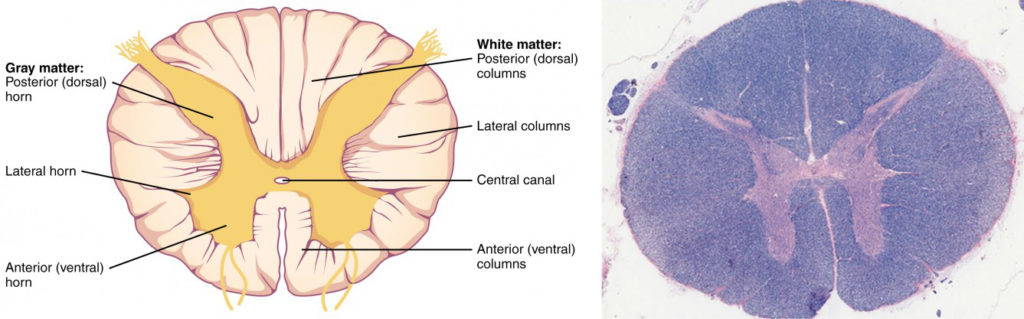
(iii) Structure and Function of the Spinal Cord
- Structure: Cylindrical structure protected by the vertebral column, meninges, and cerebrospinal fluid.
- Functions:
- Transmits nerve signals between the brain and the body.
- Integrates reflex actions.
- Diagram: Include a labeled diagram of the spinal cord showing gray matter, white matter, and central canal.
(b) Peripheral Nervous System (PNS)
(i) Somatic Nervous System
- Definition: Controls voluntary actions via skeletal muscles.
- Function: Transmits sensory information to the CNS and motor commands to muscles.
- Example: Writing or walking.
(ii) Autonomic Nervous System
- Definition: Controls involuntary actions, regulating internal organs and glands.
- Divisions:
- Sympathetic System: Activates "fight or flight" responses (e.g., increased heart rate).
- Parasympathetic System: Promotes "rest and digest" activities (e.g., slowing heart rate).
(iii) Structure and Function of the Neurone
- Structure:
- Cell body: Contains the nucleus and organelles.
- Dendrites: Receive signals.
- Axon: Transmits signals.
- Myelin sheath: Insulates the axon and speeds up impulses.
- Function: Conducts nerve impulses.
- Diagram: Include a labeled diagram of a neurone.

(iv) Classification of Neurones
- Afferent (Sensory) Neurones: Carry signals from sensory receptors to the CNS.
- Efferent (Motor) Neurones: Transmit signals from the CNS to muscles or glands.
- Intermediate (Relay) Neurones: Connect sensory and motor neurones within the CNS.
(c) Types of Nervous Actions
(i) The Reflex Arc
- Definition: A neural pathway involved in a reflex action.
- Structure:
- Sensory receptor → Sensory neurone → Relay neurone → Motor neurone → Effector organ.
- Example: Knee-jerk reflex.
(ii) Reflex and Voluntary Actions
- Reflex Actions:
- Involuntary and automatic responses to stimuli.
- Example: Blinking.
- Voluntary Actions:
- Conscious and deliberate movements.
- Example: Writing.
(iii) Differences Between Reflex and Voluntary Actions
| Aspect | Reflex Actions | Voluntary Actions |
|---|---|---|
| Control | Involuntary | Conscious |
| Speed | Rapid | Slower |
| Pathway | Reflex arc | CNS |
| Example | Withdrawal from heat | Walking |
(iv) Conditioned Reflex and Its Role in Behavior
- Definition: A learned response to a specific stimulus.
- Examples:
- Salivation when smelling food.
- Driving a car.
- Role: Enables adaptation to environmental changes through learning.
Real-World Applications
- Medical: Understanding reflexes aids in diagnosing nerve or brain damage.
- Behavioral Studies: Helps in analyzing learning patterns and conditioning in humans and animals.
- Robotics: Mimics reflex actions in artificial intelligence.
Common Misconceptions
- Misconception: Reflex actions are always simple.
- Clarification: Reflex actions can involve complex pathways, such as withdrawal from a sharp object.
- Misconception: Voluntary actions are faster than reflex actions.
- Clarification: Reflex actions are faster because they bypass conscious processing.
This structured guide combines theoretical and practical insights into nervous coordination, emphasizing its critical role in maintaining life processes.