Food webs and trophic levels
Food Webs and Trophic Levels
Understanding the interconnected relationships in ecosystems is crucial for comprehending how energy flows and matter cycles through the biosphere. This note explores the various aspects of food webs, trophic levels, and the energy dynamics within ecosystems.
(a) Autotrophs and Heterotrophs
(i) Producers: Autotrophs
Definition:
Autotrophs are organisms that produce their own food using sunlight (photoautotrophs) or chemical energy (chemoautotrophs).
Key Features:
- Form the base of the food chain.
- Use processes like photosynthesis or chemosynthesis.
- Examples: Plants, algae, and certain bacteria (e.g., cyanobacteria).
Formula for Photosynthesis:
6CO2+6H2�+Light Energy→C6H12O6+6O26CO2+6H2O+Light Energy→C6H12O6+6O2
Real-World Application:
Aquatic environments rely on phytoplankton as the primary producers, while terrestrial environments depend on plants.
(ii) Consumers: Heterotrophs
Definition:
Heterotrophs are organisms that rely on consuming other organisms for energy and nutrients.
Types of Consumers:
- Primary Consumers (Herbivores): Consume producers (e.g., deer, zooplankton).
- Secondary Consumers (Carnivores): Prey on primary consumers (e.g., snakes, small fish).
- Tertiary Consumers: Top predators that feed on secondary consumers (e.g., hawks, sharks).
(iii) Decomposers
Definition:
Organisms that break down dead organic matter, recycling nutrients back into the ecosystem.
Examples:
- Micro-decomposers: Bacteria and fungi.
- Macro-decomposers: Earthworms, insects.
Gaseous Products:
During decomposition, gases such as carbon dioxide (CO₂), methane (CH₄), and hydrogen sulfide (H₂S) are released.
(b) Trophic Levels and Energy Relationships
(i) Food Chain
Definition:
A linear sequence showing the transfer of energy and nutrients through different trophic levels.
Example:
Grass → Grasshopper → Frog → Snake → Hawk
Key Point:
Energy decreases as we move up trophic levels due to energy loss (e.g., heat).
(ii) Food Web
Definition:
A complex network of interconnected food chains illustrating multiple feeding relationships in an ecosystem.
Example:
In a forest ecosystem:
- Plants are consumed by deer, rabbits, and insects.
- These consumers are preyed on by foxes, owls, and snakes.
Misconception:
Food webs are often thought to be circular, but energy transfer is unidirectional.
(c) Energy Flow
(i) Food/Energy Relationship in Aquatic and Terrestrial Environments
- Aquatic Ecosystems:
- Primary producers: Phytoplankton.
- Consumers: Zooplankton, small fish, large fish.
- Terrestrial Ecosystems:
- Primary producers: Trees, shrubs.
- Consumers: Herbivores (deer) and carnivores (wolves).
(ii) Pyramid of Energy and Pyramid of Numbers
Pyramid of Energy
- Shows the energy available at each trophic level.
- Always upright due to energy loss (10% energy transfer rule).
Pyramid of Numbers
- Depicts the number of organisms at each trophic level.
- Can be upright (grassland) or inverted (parasitic chain).
Key Difference:
Energy pyramids focus on energy flow, while number pyramids focus on population sizes.
(d) Decomposition in Nature
(i) Role of Decomposers
- Breakdown dead matter into simpler substances.
- Release nutrients like nitrogen and phosphorus into the soil or water.
(ii) Gaseous Products
- Carbon dioxide (CO₂): Released during aerobic respiration.
- Hydrogen sulfide (H₂S): Formed during anaerobic decomposition.
- Heat energy: Generated as a by-product of microbial activity.
(iii) Demonstrations
- Composting shows CO₂ and heat release.
- Anaerobic conditions produce gases like methane.
Key Concepts and Summary
- Food chains and webs represent energy flow and interdependence among organisms.
- Trophic levels are hierarchical stages in a food chain: producers, consumers, and decomposers.
- Energy transfer is non-cyclic and diminishes up trophic levels due to heat loss.
- Decomposers play a vital role in recycling nutrients and maintaining ecosystem balance.
Real-World Applications
- Conservation efforts utilize food web studies to protect endangered species.
- Sustainable agriculture depends on understanding decomposer roles for soil fertility.
Illustration Suggestion
- Food web diagram: Include terrestrial and aquatic organisms.
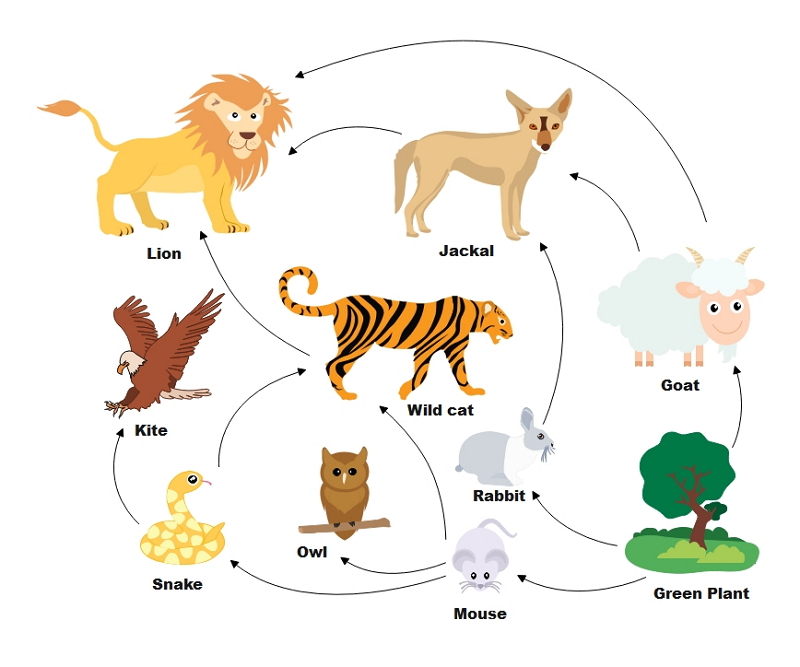
- Energy pyramid: Show energy reduction across levels.

By understanding food webs and trophic levels, we can appreciate the intricate balance sustaining life on Earth.