Economics 2023
minutes!
Question(s):
1
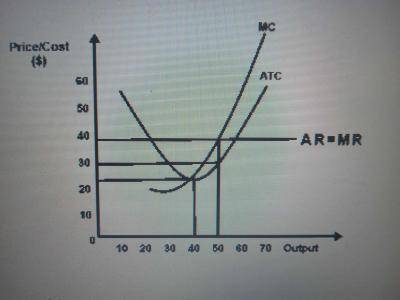
a. The equilibrium position of a firm is illustrated in the diagram above. Study the diagram and answer the following questions:
i. What is the equilibrium output level?
ii. What is the equilibrium price?
b. At the equilibrium output level, calculate the firm's:
i. Total cost
ii. Total revenue
iii. Total profit
c. Is the firm operating in the long-run or short-run? Explain your answer.
d. At the equilibrium output level, answer the following:
i. What type of market is the firm operating in?
ii. List three features of the market type identified in (d)(i).
2
a. Table 1 below represents the output levels of a firm producing hand sanitizer. Use the information to answer the following questions:
Table 1
| Output (units) | 0 | 10 | 18 | 28 | 36 | 45 |
i. If the cost function of the firm is given as C=30+4qC = 30 + 4qC=30+4q, where CCC is the total cost and qqq is the units produced, calculate the total cost (in dollars) of producing:
- 18 units
- 36 units
b. Using the cost function C=30+4qC = 30 + 4qC=30+4q, calculate the:
i. Average cost (in dollars) of producing 28 units.
ii. Average cost (in dollars) of producing 45 units.
c. What is the marginal cost (in dollars) of producing 28 units?
d. Determine the profit made from producing 45 units when the market price is fixed at $5.00 per unit.
e. What is the fixed cost of the firm? Explain your answer.
3
a. Distinguish between the following:
i. Money cost and opportunity cost.
ii. Normal goods and inferior goods.
b. Explain how the scale of preference assists the following economic groups in making efficient allocation of resources:
i. Individuals
ii. Firms
iii. Government
4
a. Define an economic system.
b. Distinguish between a capitalist economy and a socialist economy under the following:
i. Aim of production
ii. Consumer sovereignty
iii. Competition
c. State three features of land as a factor of production.
5
a. Differentiate between a sole proprietorship and a partnership.
b. List four characteristics of a sole proprietorship.
c. Outline four advantages of a public limited liability company.
6
a. Define location of industry.
b. Explain how the following factors influence where a firm is sited:
i. Raw materials
ii. Market
iii. Government policy
c. Outline three advantages of localization of industry.
7
a. Define Gross Domestic Product (GDP).
b. Describe the output approach as a method of computing national income.
c. Identify any three problems associated with the expenditure approach of calculating national income.
8
a. What is an embargo?
b. Outline any three reasons for imposing tariffs on imports.
c. Explain any three reasons against the use of tariffs.