Economics 2022
minutes!
Question(s):
1. National Income Calculations
A hypothetical national income data for a country in a particular year is presented below:
| ITEM | $MILLION |
|---|---|
| Wages and salaries | 250 |
| Income paid abroad | 75 |
| Income from self-employment | 120 |
| Stock appreciation | 5 |
| Interest | 10 |
| Income received from abroad | 50 |
| Rent | 25 |
| Depreciation allowance | 3 |
| Royalties | 2 |
| Profits and dividends | 35 |
(a) Calculate the Gross Domestic Product (GDP).
(b) Calculate the Gross National Product (GNP).
(c) Calculate the Net National Product (NNP).
2. Subsidy and Elasticity of Demand
The diagram below shows the effects of the introduction of a subsidy on the production of maize. Study the diagram and answer the following questions:
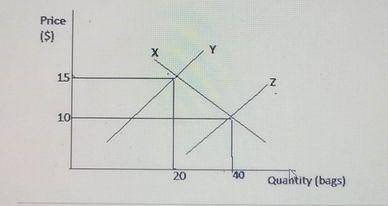
(a)
(i) Identify the curves labelled X, Y, Z.
(ii) State the direction of change in price and quantity with the introduction of the subsidy.
(b)
(i) Calculate the total revenue of producers before the introduction of the subsidy.
(ii) Calculate the total revenue of producers after the introduction of the subsidy.
(c) Calculate the percentage increase or decrease in total revenue of producers with the introduction of the subsidy.
(d) If the quantity demanded of maize increases from 20 to 40 bags as a result of a fall in price from $15 to $10, calculate the price elasticity of demand.
(e) State the type of elasticity of demand calculated in (d).
3. Business Structures and Financing
(a) Define the term limited liability.
(b) Describe four differences between a public joint-stock company and a private joint-stock company.
(c) Outline three sources of finance available to a sole proprietorship.
4. Labour Force and Efficiency
(a) Distinguish between labour force and efficiency of labour.
(b) Describe five factors that determine the size of the labour force in a country.
5. Demand and Its Determinants
(a) What is a demand schedule?
(b) Explain the following terms:
→ Effective demand
→ Composite demand
→ Derived demand
(c)
(i) Using appropriate diagrams, explain how a change in the price of a commodity influences the demand of its substitute.
(ii) Using appropriate diagrams, explain how a change in the price of a commodity influences the demand of its complement.
6. Taxation and Elasticity
(a) Explain the following types of taxes:
→ Specific tax
→ Value-added tax
(b)
(i) With the aid of diagrams, describe the effects of an indirect tax on a commodity when demand is perfectly inelastic.
(ii) With the aid of diagrams, describe the effects of an indirect tax on a commodity when demand is perfectly elastic.
7. Banking Systems
(a) Distinguish between the following:
→ Mortgage bank and merchant bank
→ Commercial bank and development bank
(b) Explain four functions of commercial banks.
8. Economic Integration
(a) What is economic integration?
(b) Outline three shortcomings of the Economic Community of West African States (ECOWAS).
(c) Highlight three achievements of ECOWAS.