Biology 2022
minutes!
Question(s):
Question 1
a.
i. What is a cell?
ii. Name three scientists associated with the discovery of the cell.
b.
i. Make a diagram, 6 cm to 8 cm long, of a plant cell and label only the organelle responsible for cell reproduction.
ii. Name one blood cell in humans that does not have the organelle labeled in (b)(i).
iii. What is the biological implication of the cell named in (b)(i) not possessing the organelle responsible for cell reproduction?
c. List six organelles found in a plant cell.
Question 2
a. Complete the table below by ticking the appropriate group to which each of the listed elements required by plants belongs:
| Element | Microelement | Macroelement |
|---|---|---|
| Hydrogen | ||
| Copper | ||
| Magnesium | ||
| Zinc | ||
| Phosphorus | ||
| Manganese | ||
| Boron | ||
| Nitrogen | ||
| Carbon | ||
| Oxygen |
b.
i. State three differences between the definitions of herbivores and carnivores.
ii. State four differences between the definitions of humans and goats.
c. What are milk teeth?
Question 3
a.
i. What is an ecological niche?
ii. State five roles played by a mango tree in its ecological niche.
b.
i. State two reasons why ecologists use sampling techniques in population studies.
ii. State four examples of sampling techniques used in population studies.
c. Name four types of fingerprints in humans.
d.
i. Name the plant used by Gregor Mendel in his experiments.
ii. State two reasons why the plant named in 3(d)(i) was used.
Question 4
a. What are conservation laws?
i. State three conservation laws.
b. State two reasons why animals are poached.
i. Name five animals that are commonly poached.
c. State four effects of excessive use of forests.
d. Explain briefly the following terms:
i. Blood transfusion.
ii. Antigen.
Question 5
a. State three differences between the alimentary canals of earthworms and cockroaches.
i. State three similarities between the alimentary canals of earthworms and cockroaches.
b. The diagram below illustrates a biological cycle. Study it and answer the following questions:
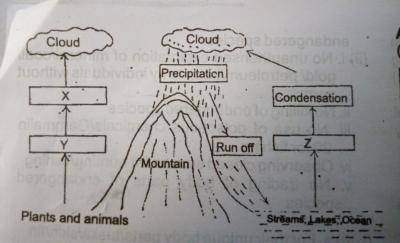
i. Name the biological cycle.
ii. Explain briefly three roles played by plants and animals in the cycle.
iii. Name the processes that occur at X, Y, and Z.
c.
i. What is decay of organic matter?
ii. Name two groups of organisms that cause decay of organic matter.
iii. State one other factor that causes decay.
iv. Name the biological cycle that involves decay.
e. Explain briefly the mode of nutrition in carnivorous plants.